Most people have heard of PTSD. Fewer know of CPTSD, or Complex Post-Traumatic Stress
Disorder, even though many seeking treatment describe something closer to this form of suffering than the usual image of trauma as a single event.
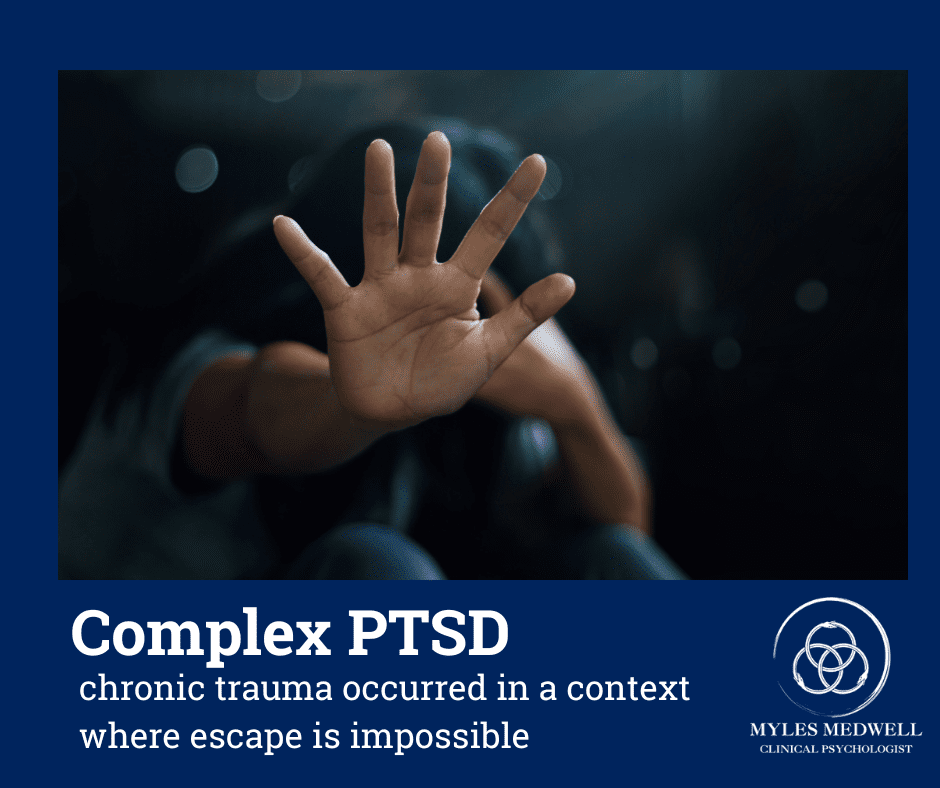
CPTSD generally describes the effects of prolonged, repeated, or inescapable trauma: childhood abuse, neglect, chronic humiliation, coercive control, domestic violence, sexual abuse, institutional violence, or early environments where the child could not rely on the Other for protection, recognition, or care.
It is important to be careful here. CPTSD should not become another master signifier that explains the subject in advance. A diagnosis may be useful, but it does not speak. The person does. In psychoanalysis, the question is not only what happened but what happened to the subject in relation to language, the body, memory, desire, and the Other.
The World Health Organization’s ICD-11 recognises CPTSD as a diagnosis distinct from PTSD.
It includes the core symptoms of PTSD : re-experiencing, avoidance, and a persistent sense of threat, along with what ICD-11 calls disturbances in self-organisation: emotional dysregulation, a negative self-concept, and difficulties in relationships. ICD-11 was adopted in 2019 and came
into effect in 2022. By contrast, DSM-5-TR does not include CPTSD as a separate diagnosis,
instead absorbing many complex trauma symptoms into PTSD and related diagnostic categories. (World Health Organization)
This difference matters. It shows that CPTSD is clinically useful but that its validity remains debated.
CPTSD, BPD, and the problem of diagnosis
One of the difficulties with CPTSD is its overlap with Borderline Personality Disorder. This is not a minor issue. It is one of the central diagnostic problems in the field.
CPTSD and BPD can both involve emotional intensity, shame, relational difficulty, dissociation, self-destructive patterns, and histories of trauma. Because of this, CPTSD is sometimes treated as
a less stigmatising name for BPD. This is too simple. But the opposite view is also too simple: that CPTSD and BPD can always be neatly separated.
The current literature suggests a mixed picture. Some studies find that CPTSD and BPD can be distinguished, especially where CPTSD involves a relatively stable but deeply negative self-concept, relational avoidance, trauma-related shame and a persistent sense of threat. BPD, by contrast, is more strongly associated with instability in self-image, volatile interpersonal patterns,
impulsivity, fears of abandonment, and recurrent self-harm or suicide. However, there is also clear overlap, and in some cases, the two diagnoses may co-occur. (Cambridge University Press
& Assessment)
This is why it is clinically unhelpful to say, “BPD is really CPTSD,” just as it is unhelpful to
dismiss CPTSD as merely fashionable language. Both avoid the harder question: what function does the diagnosis serve, and what does it obscure?
From a psychoanalytic perspective, diagnosis may orient the work, but it must not replace listening. The subject cannot be reduced to a trauma category, a personality label, or a symptom cluster. The question remains: how has suffering been organised, repeated, defended against, and spoken?
Trauma is not only an event
In ordinary language, trauma is often spoken of as an event. Something happened. Something was done. Something was witnessed. This is true and should not be minimised. Ferenczi’s work
remains important because he refused to reduce trauma to fantasy alone. In “Confusion of
Tongues Between Adults and the Child,” Ferenczi emphasised the violence of the adult’s demand imposed on the child’s world of tenderness.
Psychoanalysis also asks what happens when an event cannot be metabolised psychically.
Freud’s work on hysteria, repetition, and the death drive shows that trauma is not only remembered; it returns. It returns in symptoms, dreams, bodily disturbances, compulsions, repetitions in love, and in the strange ways a person may find themselves repeatedly in a position they consciously wish to escape.
In Beyond the Pleasure Principle, Freud’s account of repetition compulsion suggests that the traumatic is not simply what causes pain. It is what insists, what returns, what the subject cannot yet place within ordinary memory or meaning. Lacan later gives this a sharper formulation through the Real. Trauma is not merely an unpleasant memory, but an encounter with something
that could not be symbolised at the time.
For this reason, complex trauma often appears not as a single story but as a structure of repetition. The person may know rationally that the danger is over but still live as though it
remains present. They may know a relationship is different from the past but still experience the Other as threatening, abandoning, intrusive, or humiliating. The body may react before speech
arrives.
How CPTSD may appear
People who identify with CPTSD often describe difficulty regulating affect. Anger, panic,
shame, disgust, collapse, or numbness may arrive with force. These reactions can seem
disproportionate to the present situation but often make sense when understood in relation to
earlier experiences where the subject had no adequate symbolic or relational support.
There may be a persistent negative self-concept: a sense of being damaged, bad, unlovable, too much, not enough, or somehow outside the world of others. This is not ordinary low self-esteem.
It is often a shame-bound position in relation to the Other. The subject may feel not just that something bad happened but that they themselves are the bad object.
Relationships are often where complex trauma becomes most visible. Trust may be difficult.
Dependency may feel dangerous. Desire may be confused with danger, obligation, or engulfment. The subject may withdraw, comply, attack, appease, or repeatedly find themselves in bonds where earlier trauma is staged again in another form.
Dissociation is also common. Some people describe leaving their body, losing time, becoming unreal, feeling emotionally dead, or watching themselves from outside. Winnicott’s “Fear of Breakdown” is useful here: what is feared as coming in the future may concern something that already happened psychically but could not be experienced at the time because there was no ego
sufficiently organised to experience it.
Why symptom management is not enough
None of this means stabilisation, safety, or practical support is unimportant. In some cases, especially with severe dissociation, suicidality, substance dependence, violence, or unstable daily
functioning, treatment must first establish enough safety for speech to occur. Psychoanalysis is not a reckless invitation to flood the subject with traumatic material.
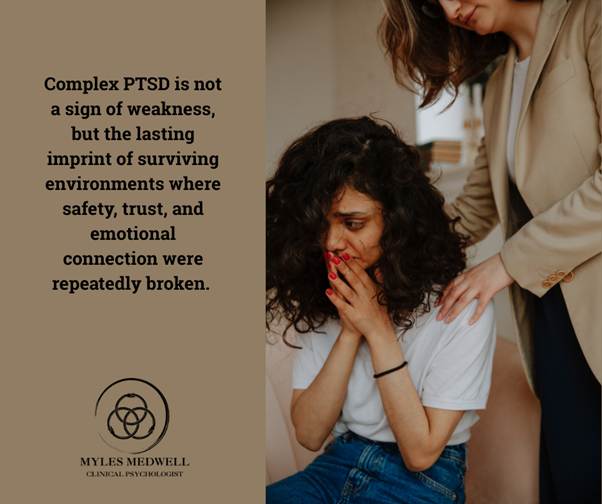
However, symptom management alone is rarely sufficient. Complex trauma is not only an overactive nervous system, a set of distorted cognitions, or a failure of emotional regulation. It
concerns how a subject has been marked by the Other, how the body has carried what could not be said, and how repetition takes the place of remembering.
The psychoanalytic position is that the symptom has a logic. It may be painful, destructive, and
unwanted, but it is not meaningless. It is a formation of the unconscious. It says something, even if it says it badly, indirectly, or through the body.
This is where psychoanalysis differs from approaches that aim too quickly at correction. The task is not simply to calm the symptom but to hear what is at stake in it. What has been repeated? What demand has been internalised? What has remained unsaid? What place has the subject occupied for the Other? What desire has had to be abandoned to survive?
The analytic frame and complex trauma
A psychoanalytic approach to complex trauma begins with speech. Not with a protocol imposed from outside, but with the subject’s own words, repetitions, contradictions, silences, jokes, dreams, slips, bodily complaints, and points of impasse.
The frame matters. Regular sessions, consistency, confidentiality, and the analyst’s position are not secondary features of treatment. They are part of treatment. For someone whose early life was marked by intrusion, unpredictability, abandonment, or misrecognition, the analytical frame may become one of the first places where speech is not immediately corrected, reassured, moralised, or turned into advice.
This does not mean the analyst simply provides warmth or support. The work is more difficult. The analyst listens for the unconscious, the signifier, and the place where the subject’s suffering repeats itself in speech. The aim is not to become the good Other who finally repairs the past. The aim is to make possible a different relation to what has been repeated.
Transference is central here. In complex trauma, the analyst may quickly be seen as dangerous, abandoning, intrusive, indifferent, seductive, withholding, or all-knowing. This is not an obstacle to the work. It is often the work itself. What has been lived with the Other returns in the analytic
relation but under conditions where it may finally be spoken rather than merely repeated.
Recovery, if that is the right word
Recovery from complex trauma is rarely a clean movement from illness to health. Psychoanalysis is suspicious of fantasies of total repair. The point is not to become untouched by the past or to produce a regulated, optimised, functional self.
Something does shift, however. The subject may become less governed by repetition. Shame
may loosen. The body may no longer have to speak so violently. Relationships may become less organised around danger, abandonment, or demand. The person may begin to distinguish the present Other from the Other of the past.
Most importantly, the subject may begin to encounter something of their own desire. This is no small thing. Complex trauma often forces a life to be organised around survival, compliance, vigilance, or refusal. Psychoanalysis opens a space where the question can become different: not only “what happened to me?” but “what do I want, beyond what happened?”
Myles Medwell Psychology is located at 53 Erin Street, Richmond, Melbourne. The practice offers psychoanalysis for adults and older adolescents seeking to speak about trauma, repetition,
symptoms, desire, and the unconscious.
A psychoanalytic approach may be suitable for those who have found that symptom-focused
therapy has not reached the place from which their suffering speaks. It may also be suitable for those who have been given diagnoses such as CPTSD, PTSD, BPD, dissociation, anxiety, depression, or functional symptoms, but who feel that the diagnosis does not fully account for their experience.
The first step is not to decide in advance what the work will be. It is to begin speaking.
References
American Psychiatric Association. Diagnostic and Statistical Manual of Mental Disorders:
DSM-5-TR. 5th ed., text rev. Washington, DC: American Psychiatric Association Publishing,
2022.
Cloitre, Marylène, Donn W. Garvert, Brandon Weiss, Eve B. Carlson, and Richard A. Bryant.
“Distinguishing PTSD, Complex PTSD, and Borderline Personality Disorder: A Latent Class Analysis.” European Journal of Psychotraumatology 5, no. 1 (2014): 25097. This is the key empirical paper used for the CPTSD/BPD distinction. (PMC)
Ferenczi, Sándor. “Confusion of Tongues Between Adults and the Child: The Language of
Tenderness and Passion.” 1933. In Final Contributions to the Problems and Methods of Psycho-Analysis. London: Karnac, 1994.
Freud, Sigmund. “The Aetiology of Hysteria.” 1896. In The Standard Edition of the Complete Psychological Works of Sigmund Freud, Vol. 3. London: Hogarth Press, 1962.
Freud, Sigmund. “Remembering, Repeating and Working-Through.” 1914. In The Standard Edition of the Complete Psychological Works of Sigmund Freud, Vol. 12. London: Hogarth Press, 1958.
Freud, Sigmund. “Beyond the Pleasure Principle.” 1920. In The Standard Edition of the
Complete Psychological Works of Sigmund Freud, Vol. 18. London: Hogarth Press, 1955.
Karatzias, Thanos, Martin Bohus, Mark Shevlin, Philip Hyland, Jonathan I. Bisson, Neil P. Roberts, and Marylène Cloitre. “Distinguishing Between ICD-11 Complex Post-Traumatic Stress Disorder and Borderline Personality Disorder: Clinical Guide and Recommendations for Future Research.” The British Journal of Psychiatry 223, no. 3 (2023): 403–406. This directly supports the article’s point that CPTSD and BPD can be clinically distinguished, but remain easily confused in practice. (PubMed)
Lacan, Jacques. The Seminar of Jacques Lacan, Book XI: The Four Fundamental Concepts of
Psychoanalysis. Translated by Alan Sheridan. New York: Norton, 1981.
Winnicott, D.W. “Fear of Breakdown.” International Review of Psycho-Analysis 1 (1974): 103–107.
World Health Organization. ICD-11 for Mortality and Morbidity Statistics. Geneva: World Health Organization. The ICD-11 is the classification system in which CPTSD is formally recognised as distinct from PTSD. (ICD-11)