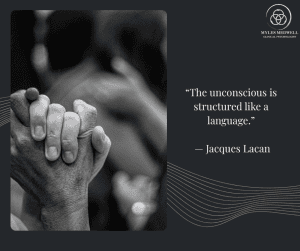
There is a particular kind of exhaustion that can arrive when parenting kids in their adolenscence years. This is not the bodily exhaustion of early childhood, marked by sleepless nights and constant vigilance, but something more disorienting—a confrontation with what Lacan termed the Otherness of the adolescent subject. As Lacan writes, “the subject is always, in some sense, a stranger to himself” (Lacan, Seminar II, 1954–55). If these experiences sound familiar, it is not a sign of failure, but a sign of how disorienting and open-ended this stage can be. There is no singular authority here but a shared attempt to navigate the unknown.
If parents find themselves disoriented in this way, it need not be read as failure. Adolescence, as known to experience, is one of the more turbulent moments of subjective constitution, and what is at stake beneath the conflict, the withdrawal, the volatility, can shift the analytic ear. Both toward the adolescent and toward the parental function itself.
What Might Adolescence Be
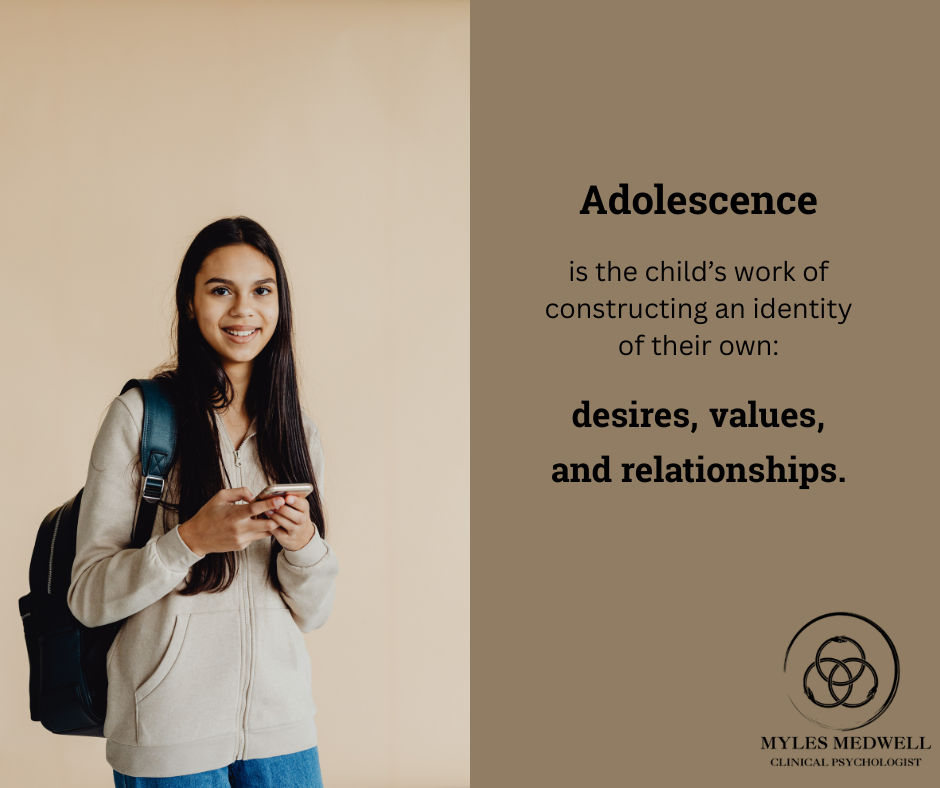
Popular discourse tends to reduce adolescence to hormones and rebellion. Not entirely wrong, but thin. Psychoanalysis, among other traditions, offers a different lens which for one foreground subjective complexity and ambiguity rather than a fixed developmental script. As Lacan put it, “the entry into the symbolic order is always paid for by a certain loss” (Lacan, Écrits, 1966). There is no master theory here, only provisional frameworks for thinking through what cannot be fully known in advance, and what must be invented, often painfully, in the moment.
Lacan’s later teaching, particularly the formulas of sexuation in Seminar XX, places the adolescent before something for which there is no rehearsal which is that there is no sexual relation, and a position must nevertheless be taken. As Lacan states, “there is no such thing as a sexual relationship” (Lacan, Seminar XX: Encore, 1972–73, p. 131), indicating a structural impossibility that the adolescent must confront. But this is just one way of describing a complex process. Other languages, cultures, and disciplines offer their own, equally valid perspectives. The conflict, withdrawal, or excess that emerges may be read as the outward sign of an inner restructuring, not as pathology, and certainly not as something with a single explanation.
The shift, then, is from what is wrong with this adolescent? toward something closer to: what is the subject attempting to become, and what kind of presence does not foreclose that becoming?
Why Is It Hard for Parents Too
The upheaval reverberates throughout the family’s symbolic structure. Watching a child begin to separate, to prefer their friends, to challenge authority, to hold opinions that cut against one’s own, can stir emotions that are not always nameable. Grief, sometimes diffuse and sometimes acute. A sense of rejection where none was meant. Old material from one’s own adolescence and family of origin. Anxiety about whether one has done enough, said enough, prepared them at all for a world that feels increasingly precarious.
A point worth holding here is that these affects are rarely only reactions to the present. They tend to be entwined with the parents’ own unconscious history, with the vicissitudes of their own adolescence, with their relationship to their own parental figures, with unresolved losses and rejections that may have lain quiet for years before being stirred again by the child who is becoming someone else. As Freud observed, “the child shall be the father of the man” (Freud, ‘Analysis of a Phobia in a Five-Year-Old Boy’, 1909). These observations are not intended to dictate meaning, but to offer a possible lens. Each family and individual will find their own significance in the shifting terrain of adolescence.
When Adolescents Struggle, It May Be Something More
Not all adolescent distress is part of the developmental work. One of the harder tasks of the parental position is distinguishing between turbulence to be expected and signs of something more serious. Persistent low mood or withdrawal lasting weeks rather than days, and not tied to a clear precipitating event, is worth attention. So too significant changes in eating, sleeping, or school attendance that represent a meaningful departure from prior functioning. Self-harm, or expressions of hopelessness or even when said in passing or appearing to be attention-seeking, should be taken seriously rather than dismissed. Escalating conflict at home that has begun to feel physically threatening, or that is leaving family members feeling unsafe, also belongs in this category, as does a withdrawal from all social connections rather than the ordinary preference for peers over parents. Distress around questions of identity, including gender and sexuality, where the distress itself appears to be the symptom rather than the exploration, is worth holding in mind.
None of these signs necessarily indicates a serious disorder. They suggest that the adolescent may be carrying something they cannot manage alone, and that professional support, for the young person, the family, or both, is worth pursuing.
A Psychoanalytic Approach To The Work
Adolescents are often reluctant clients. They may attend because a parent or school has insisted, rather than from any motivation of their own. They may be sceptical of adults who claim to want to help, having previously been assessed, labelled, or advised in ways that felt diminishing rather than respectful. A psychoanalytic orientation takes these realities seriously. Rather than arriving with a predetermined agenda or a curriculum of skills to be taught, the aim is to create a space where the young person can begin to speak in their own terms, at their own pace, about what is actually going on for them and not what the adults around them think is going on.
This matters enormously to adolescents. A core part of what they are working through is the question of whether they have an inner life that belongs to them, one that is not simply an extension of parental anxieties or expectations. Work that honours this, that treats the young person as the authority on their own experience, is far more likely to be engaged with meaningfully. There is no pressure to reach conclusions or achieve particular outcomes. The work unfolds according to what the young person brings and what they need.
Holding On While Letting Go
One of the paradoxes of the parental position in adolescence is that it requires two apparently contradictory things at once. Genuine presence and genuine separation. Too much holding on, through monitoring, controlling, demanding closeness, and the family becomes a force to be escaped from. The conflict intensifies, the secrecy deepens, the distance grows. Too much letting go, through disengagement and withdrawal, and the adolescent loses an anchor they still, despite appearances, need.
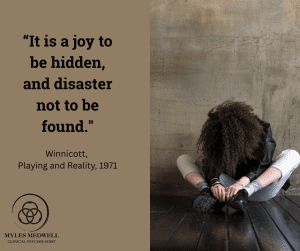
Winnicott’s concept of the holding environment, elaborated across the papers gathered in The Maturational Processes and the Facilitating Environment (1965), offers one way of thinking about the relational space needed for growth. As Winnicott writes, “It is a joy to be hidden, and disaster not to be found” (Winnicott, Playing and Reality, 1971, p. 128), capturing the tension adolescents often feel between separation and connection. This is not a formula or a guarantee, but a conceptual offering, one among many possibilities for holding the paradoxes of adolescence and parenting. What works, or what is needed, will always be particular to those involved.
What Family Conflict Might Be Communicated
Conflict during adolescence is close to universal, though its form varies. Some families experience conflict primarily about control and who decides, and on what terms. Others experience it as a kind of affective flooding, where small disagreements rapidly escalate into crises. Others find themselves in a sort of cold war, a household characterised by silence, withdrawal, and mutual avoidance.
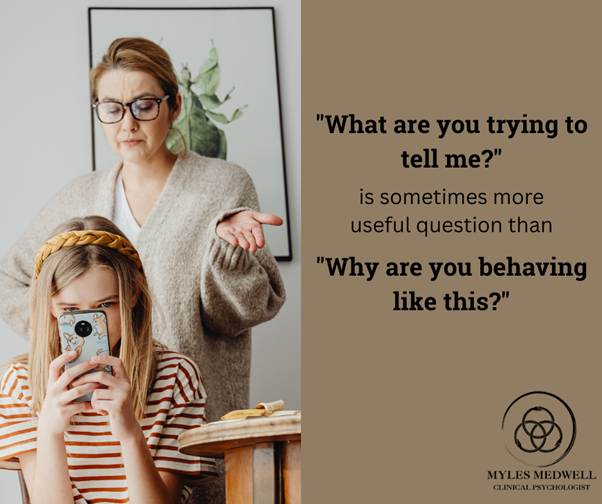
Within a psychoanalytic frame, conflict tends to communicate something. The question is what. It may be communicating that the adolescent feels unseen or unheard in their singularity. It may be communicating that something painful in the family system, an unspoken grief, an unresolved tension between the parents, an anxiety about the future, is being spoken through the adolescent’s behaviour. It may be communicating that the adolescent is struggling with something they cannot put into words, and the only register currently available is the register of conflict. As Michael Plastow notes, “the symptom is a message addressed to the Other” (Plastow, What is a Child?, 2018, p. 102). These are not universal truths but possible readings, and the invitation is to remain curious, to tolerate uncertainty, and to listen for what might be at stake without presuming to know in advance.
When to Seek Professional Support
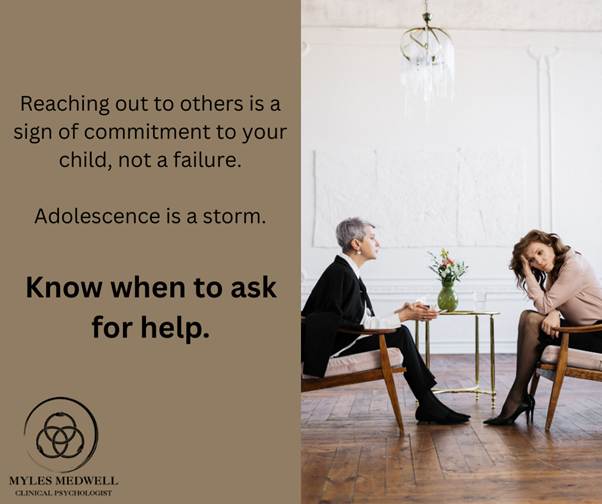
There remains a tendency, in many families, to seek professional support only when things have reached a crisis point. This is understandable, given the realities of family life and the lingering cultural hesitancy around seeking help. While Freud’s observation that “unexpressed emotions will never die. They are buried alive and will come forth later in uglier ways” (Freud, Letters, 1910) offers one way of thinking about the risks of waiting, it is not a universal law but simply a reminder that difficulties need not be endured in isolation. Some families find it helpful to reach out earlier, when conflict is escalating or something does not feel right, but this, too, is a matter of particular context and need. There is no single threshold or rule for when to seek support, only an openness to different timings and choices.
Professional support can take many shapes, depending on what feels workable and meaningful for those involved. This might include individual analytic work for the adolescent, a space for parents to explore their own responses, or sometimes family sessions. The options, whether in person or via telehealth, with different funding avenues, are not solutions in themselves, but possible resources. The decision to seek help, and the form it takes, remains with each family and individual, shaped by their own priorities and circumstances.
What Can Be Done In The Meantime
While professional support can make a difference, there are also everyday practices that some parents find helpful. These are not prescriptions, but invitations to experiment. Staying curious rather than reactive; pausing before responding; wondering what might be communicated beneath the surface. As Winnicott notes, “It is in playing and only in playing that the individual child or adult is able to be creative and to use the whole personality, and it is only in being creative that the individual discovers the self” (Winnicott, Playing and Reality, 1971, p. 54). Small gestures of connection. A meal, a check-in, a message may be meaningful, but not always. Taking one’s own affective experience seriously, seeking support for oneself, or loosening surveillance are options to be weighed, not requirements. Ultimately, what works will depend on each family’s unique dynamics, resources, and values.
Adolescence is a storm. It passes. There is no single path through it, nor a definitive map for how families or adolescents should respond. If anything in this piece resonates, challenges, or unsettles, it is intended as an opening rather than a closure but a gesture toward dialogue, not a final word. The hope is simply to contribute to a conversation that remains necessarily unfinished, shaped by the lived experience of all who move through this terrain.
A Short Reading List
For readers who wish to follow some of these threads further:
- Chierens, Christian. A Reading of Anxiety: Lacan’s Seminar X. London: Karnac, 2012.
- Freud, Sigmund. “Analysis of a Phobia in a Five-Year-Old Boy” (1909). In The Standard Edition of the Complete Psychological Works of Sigmund Freud, Vol. 10. London: Hogarth Press, 1955.
- Freud, Sigmund. “Three Essays on the Theory of Sexuality” (1905). In The Standard Edition, Vol. 7. London: Hogarth Press, 1953.
- Freud, Sigmund. “Letters (1910).” (Specify recipient or collection if possible.)
- Lacan, Jacques. Écrits. Paris: Seuil, 1966.
- Lacan, Jacques. The Seminar of Jacques Lacan, Book II: The Ego in Freud’s Theory and in the Technique of Psychoanalysis, 1954–1955. Trans. Sylvana Tomaselli. Cambridge: Cambridge University Press, 1988.
- Lacan, Jacques. The Seminar of Jacques Lacan, Book XX: Encore, 1972–1973. Trans. Bruce Fink. New York: Norton, 1998.
- Plastow, Michael. What is a Child? Childhood, Psychoanalysis, and Discourse. London: Karnac, 2018.
- Winnicott, D.W. Playing and Reality. London: Tavistock, 1971.
- Winnicott, D.W. The Maturational Processes and the Facilitating Environment. London: Hogarth Press, 1965.