Why Real Change Isn’t About Feeling Better
We live in an age saturated with the language of healing. Wellness apps, self-help books, therapy influencers — all of them carry a similar promise: regulate yourself, optimise your mind, become whole. It’s a compelling offer. But what if this vision of mental health, however well-intentioned, misses something essential about what it means to be human?
Psychoanalysis begins from a very different place…and understanding that difference might be the most important thing you learn before choosing the kind of support that’s right for you.
The Promise of Healing Culture
Modern ‘healing culture’ tends to frame psychological distress as a problem to be solved. The goal is regulation: calm the nervous system, strengthen the ego, build resilience, return to baseline. There is real value in some of this. Practical tools can help people manage symptoms, and no one should dismiss the relief that comes from feeling more stable.
But this model carries an implicit promise — “Be whole. Be fixed. Be regulated.” — and with it, a subtle but significant assumption: that the self is essentially a coherent, stable entity that has somehow gone wrong, and that the work of therapy is to restore it to its proper functioning.
Psychoanalysis, from its very foundations, challenges this assumption.
The Ego Is Not Master in Its Own House
Freud’s most provocative insight was deceptively simple: we are not in control of ourselves in the way we imagine. As he put it, “The ego is not master in its own house.” There are forces at work within us – our unconscious wishes, conflicts, and desires – that shape our behaviour, our relationships, and our suffering in ways we cannot directly see or manage.
This is not a counsel of despair. It is, rather, an invitation to curiosity. If the self is not a stable, unified ‘I’ narrating a coherent story, then perhaps the most important therapeutic work is not strengthening that story, but learning to listen to what disrupts it — the slips of the tongue, the recurring dreams, the symptoms that return no matter how hard we try to push them away.

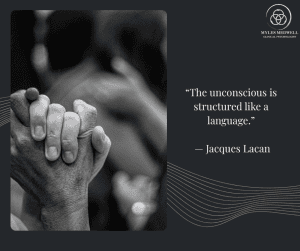
Jacques Lacan, the French psychoanalyst who reread Freud through the lens of language and philosophy, captured this beautifully: “The unconscious is structured like a language.” What this means, in practice, is that analysis follows speech — not the ego’s wish to be soothed, but the movements and meanings that emerge when a person is truly listened to.
Why Do We Keep Repeating the Same Patterns?
One of the most common questions people bring to therapy is some version of: “Why do I keep doing this?” Why do I end up in the same kinds of relationships? Why do I self-sabotage when things are going well? Why does the anxiety always come back?
Healing culture has ready answers: trauma, attachment style, cognitive distortions, dysregulated nervous systems. Sometimes these explanations are useful and accurate. But they can also become a way of pinning the cause without ever encountering what actually drives the repetition.
Freud identified something he called the ‘compulsion to repeat’. A force that overrides the simple pleasure principle, that pushes us toward experiences that seem to work against our own wellbeing. Sabina Spielrein, one of psychoanalysis’s most original and underappreciated thinkers, put it starkly: “The cause of coming-into-being is destruction.” New life, new meaning, new identity…these emerge not from comfort and consolidation, but from disintegration and transformation.

This is uncomfortable. It runs counter to the promise of a calmer, more regulated self. But it points toward something psychoanalysis takes seriously: that the path through suffering is not always around it.
What the Couch Is Really For
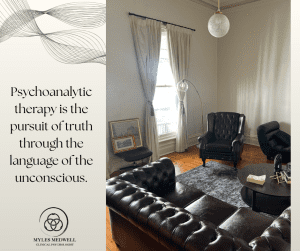
In psychoanalytic tradition, the consulting room or the ‘couch’ is not primarily a place of comfort. It is, as one way of putting it goes, a place of estrangement. A space where you can become unfamiliar to yourself. Where the curated story you have constructed about who you are, why you do what you do, what you want, begins to loosen.
The theologian Rudolf Otto described the experience of the sacred as ‘mysterium tremendum et fascinans’ — a mystery that is both terrifying and irresistibly compelling. Psychoanalysis, at its best, has something of this quality. It does not offer the comfort of answers. It offers the possibility of a genuine encounter with what is most alive and most unknown in you.
This is what George Bataille described as the ‘sovereignty of the subject’ — not the ego in control, but a person learning to take up a position in relation to what speaks in them: the dreams, the slips, the symptoms that exist beyond their curated self-presentation.
The Ethics of Desire
Lacan’s ethical principle for psychoanalysis was radical in its simplicity: “Do not give up on your desire” (ne pas céder sur son désir). This is not permission to do whatever you want. It is something more demanding than that.
It means: don’t betray the question your symptom is asking. Don’t silence the unconscious with a ready-made explanation. Don’t settle for feeling better if ‘feeling better’ means no longer being in contact with what most matters to you.
The ethics of psychoanalysis are not about optimisation. They are about fidelity — to the truth of your experience, to the complexity of your desire, to the possibility of becoming someone you have not yet been.
Tossed by the Waves, But It Does Not Sink
The motto taken up by the Freudian School of Melbourne captures something essential: “Tossed by the waves, but it does not sink.” This is not a promise of calm waters. It is something more honest and, in the end, more hopeful.

Psychoanalysis does not offer to remove your difficulties, silence your symptoms, or return you to a pre-suffering state. What it offers is a relationship — with your own history, your own desire, your own unconscious — that is sturdy enough to survive the storm. Not wholeness, but resilience of a different kind: the kind that comes from knowing yourself more honestly.
This is what it means to connect with your singularity — not to become a better version of a generic self, but to discover who you actually are and what you actually want, beneath the layers of adaptation and performance that everyday life requires of us.
Dare to speak. The desire to do so is already the beginning.
About Myles Medwell
Myles Medwell is a Clinical Psychologist based in Richmond, Melbourne, with a particular interest in Lacanian psychoanalytic therapy — an approach that values reflection, curiosity, and the kind of change that unfolds over time. His style is thoughtful and collaborative, and he aims to create a space where each person feels safe to speak in their own way, at their own pace.
Myles works with children, young people, and adults across a wide range of emotional and psychological concerns, offering both ongoing psychoanalytic therapy and comprehensive psychological assessments, including for complex mental health presentations. He holds qualifications including a Master of Psychology (Clinical) and is registered with AHPRA and a member of the Australian Clinical Psychology Association.
His practice accepts Medicare rebates, NDIS funding, and TAC referrals, with a sliding scale fee structure available. Telehealth is offered for select services. Referrals are welcome from GPs, psychiatrists, and allied health professionals.
Practice address: 53 Erin Street, Richmond, Melbourne VIC
Fill up the Contact Form on the Website : www.mylesmedwell.com.au for a Free 15-minute phone consultation. Available for those curious to explore whether this approach is the right fit.