Lacanian Psychoanalysis
Lacanian Psychoanalysis is a unique and philosophically rich approach to psychotherapy, rooted in the teachings of French psychoanalyst Jacques Lacan (1901–1981). Lacan was a psychiatrist and philosopher who revolutionised psychoanalysis by reinterpreting Freud through the lens of structural linguistics, philosophy, and modernist thought.
This approach invites a deep, reflective journey into the unconscious, helping individuals uncover patterns in language, emotion, and identity that often underlie persistent psychological struggles – revealing insights that extend well beyond surface-level symptom management.
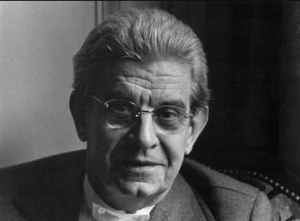
Jacques Lacan, Image Credit to Wikipedia
The Lacanian Orientation
Lacanian psychoanalysis place emphasis on the structure of language, the function of desire, and the division of the subject. It begins from the idea that the unconscious is not a storehouse of hidden content, but a dynamic structure that speaks — often without us knowing it.
In Lacanian work:
The unconscious is understood as being structured like a language,
Desire is not something we can grasp directly, but something that shows itself in symptoms, speech, and dreams,
The subject is not whole or unified, but divided — never fully transparent to itself.
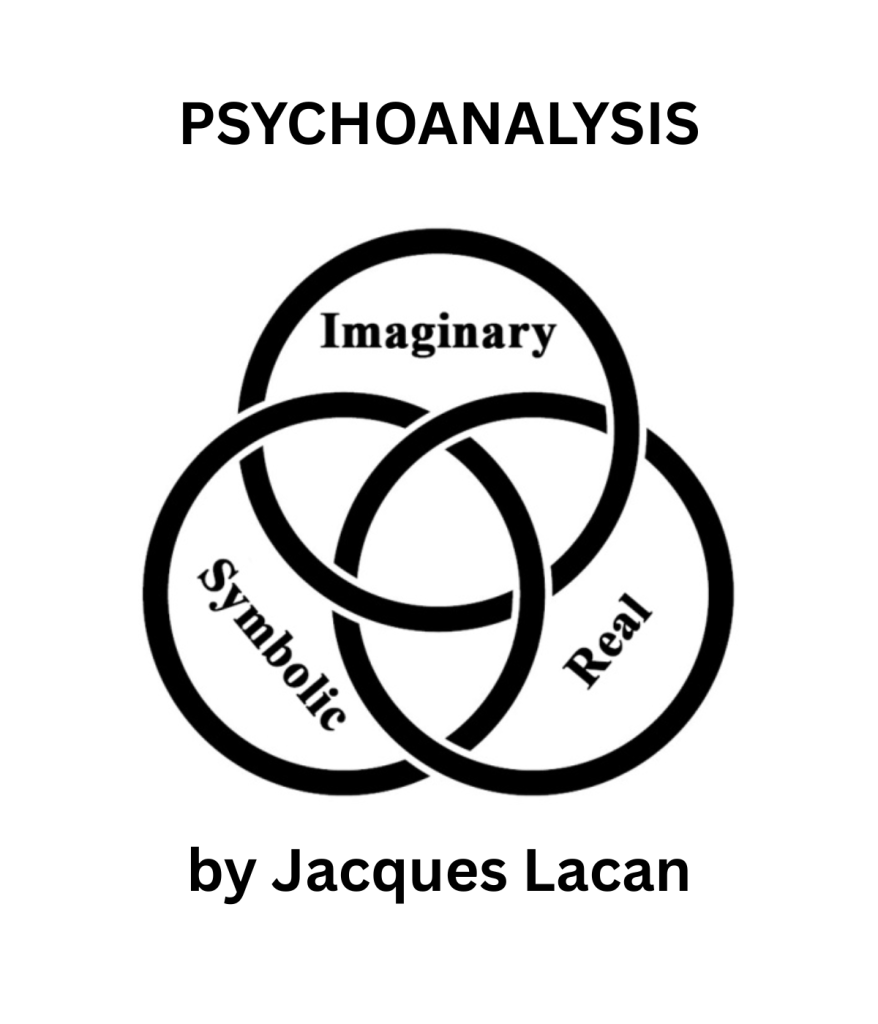
The aim of analysis is not integration or healing, but the possibility of creating a new relation to one’s symptom, one’s desire, and one’s place within the symbolic structures — such as language, family, and culture — that shape us from the beginning.
A Brief History of Psychoanalysis
Psychoanalysis began in the late 19th century with the work of Sigmund Freud, who proposed that symptoms express unconscious conflicts — desires and fears that have been repressed and return in disguised form. Freud introduced techniques such as free association, dream interpretation, and attention to transference as ways of accessing the unconscious.
Early in the 20th century, Freud’s dialogue with Carl Jung shaped the expansion of psychoanalytic thought. Jung’s contributions focused on dreams, symbols, and the concept of a collective unconscious, though he eventually broke with Freud and established his own school of analytic psychology. Nonetheless, his early work helped deepen the clinical understanding of how unconscious material emerges in imagery and fantasy.
Freud’s ideas were further developed by theorists such as Melanie Klein, Donald Winnicott, and Wilfred Bion, who explored the emotional world of the infant and the dynamics of early internal object relations.
In the mid-20th century, Jacques Lacan returned to Freud’s texts and proposed a radical re-reading: that the unconscious is not just a set of repressed contents but a structure that speaks through language. Lacan placed psychoanalysis in conversation with structural linguistics, philosophy, and modern culture, revitalising it for contemporary times.
Psychoanalysis continues to evolve today, but its essential concern remains unchanged: listening seriously to the subject’s speech, so that something previously unspoken may come to light.