What Is Lacanian Psychoanalysis?
What follows is offered as a saying and not necessarily as an answer. It speaks some words toward a question that is asked often, for those who want to know something of what this is.
Lacanian psychoanalysis is one of the more demanding traditions within the broader field of depth psychology. It is also, in Melbourne, among the rarest.
Language, the Unconscious, and the Question of Desire
There is a particular kind of impasse that brings people to psychoanalytic work. Not the impasse of not knowing what is wrong. Many people know perfectly well. The impasse of knowing and still not being able to change anything. The pattern continues. The relationship ends in the same way. The anxiety returns, despite the tools, the insight, the years of effort.
Cognitive frameworks offer an explanation for this in terms of faulty beliefs or maladaptive schemas. Psychoanalysis offers a different explanation. The relevant processes are not primarily cognitive, and they operate, by definition, outside the reach of conscious reflection. What keeps the pattern going is a structure organised at the level of the unconscious, sustained by desire, and expressed through the specific language the subject uses to describe their life.
It is that structure which Lacanian psychoanalysis takes as its concern.
Lacan’s Return to Freud
Jacques Lacan was a French psychiatrist and psychoanalyst whose seminars, delivered in Paris from 1953 to 1980, constitute one of the most sustained and demanding engagements with Freudian theory in the history of the discipline. His central project was not to revise Freud but to return to him, or, more precisely, to retrieve what Lacan believed had been systematically misread by the ego-psychology tradition dominant in the postwar United States.
Ego psychology, broadly, held that the aim of psychoanalytic treatment was the strengthening of the ego, understood as the rational, reality-oriented part of the mind, and its adaptation to the demands of the social world. Lacan regarded this as a profound misreading of Freud’s discovery. Freud had not discovered the ego. He had discovered the unconscious, a radically heterogeneous agency that does not obey the laws of logic, time, or contradiction, and that speaks in the gaps and failures of ordinary speech.
Lacan’s return to Freud was therefore also a return to the unconscious as the primary object of psychoanalytic attention. His theoretical innovation was to describe its structure in terms drawn not from biology or neurology but from linguistics, specifically the structural linguistics of Ferdinand de Saussure and the work on language functions by Roman Jakobson (Lacan, 1957/2006; Jakobson, 1956).
The Unconscious Is Structured Like a Language
Lacan’s most cited proposition, that the unconscious is structured like a language, is precise and often misheard. It is sometimes taken to mean that the unconscious communicates in sentences, or that it contains thoughts waiting to be translated into words. What it says is that the unconscious operates according to the same formal principles as language, through substitution and displacement, condensation and metaphor, the sliding of meaning under apparently fixed terms.
Saussure had described the sign as the combination of a signifier (the sound-image, or word) and a signified (the concept). He also described the relationship between them as arbitrary. There is no natural connection between the word ‘mother’ and the concept or the person it designates. Lacan took this further. He argued that in the unconscious, signifiers chain together without stable anchorage to any fixed signified. Meaning does not land. It slides. And it is precisely in these points of sliding, in the gaps and slippages of speech, that the unconscious makes itself known (Lacan, 1957/2006; Saussure, 1916/1983).
This has a direct clinical implication. If the unconscious is structured like a language, then it can be read, not decoded exactly, but attended to in its own terms. The analyst’s ear is trained not on the general content of what a person says, but on the specific signifiers they return to, the places where speech hesitates or contradicts itself, the moments where something says more than the speaker intended. As Lacan puts it in ‘The Function and Field of Speech and Language in Psychoanalysis’, the subject receives his own message back from the Other in inverted form (Lacan, 1953/2006).
Three Registers: The Real, the Symbolic, and the Imaginary
Central to Lacan’s theoretical architecture is a distinction between three registers, which he maintained throughout his seminars as a framework for understanding the structure of subjectivity. These are the Real, the Symbolic, and the Imaginary. They are not stages of development or levels of consciousness. They are distinct dimensions of human experience that are always simultaneously in play.
The Imaginary is the register of images, identifications, and the dual relation between self and other. The ego, understood as the image we have of ourselves, is formed in the Imaginary. Lacan’s account of the mirror stage (1949/2006) describes the infant’s earliest identification with their reflection as the foundational moment of ego formation. But this identification is always a misrecognition. The image in the mirror is more unified, more stable, more whole than the fragmented bodily experience the infant actually inhabits. The ego is, from the outset, founded on an illusion.
The Symbolic is the register of language, law, and the signifier. It is the order into which the subject is born, and which precedes and determines them in ways they cannot fully apprehend. The Symbolic includes not only words but the entire network of social, cultural, and familial structures that organise a subject’s world. Lacan’s concept of the Other, written with a capital O, refers to this order, the locus of the signifier, the site from which the subject receives their identity and their desire.
The Real is the most difficult of the three registers to characterise, precisely because it is defined by what resists symbolisation. The Real is not reality in the ordinary sense. It is what cannot be absorbed into the Symbolic order, what returns insistently, what makes itself felt as trauma, as the body’s refusal to comply, as the persistent remainder that no amount of interpretation fully dissolves. Lacan described it as ‘that which always returns to the same place’ (Lacan, 1964/1981, p. 49). The four fundamental concepts of psychoanalysis, comprising the unconscious, repetition, transference, and the drive, are all elaborated in Seminar XI in relation to the Real (Lacan, 1964/1981).
Desire, Lack, and the Subject
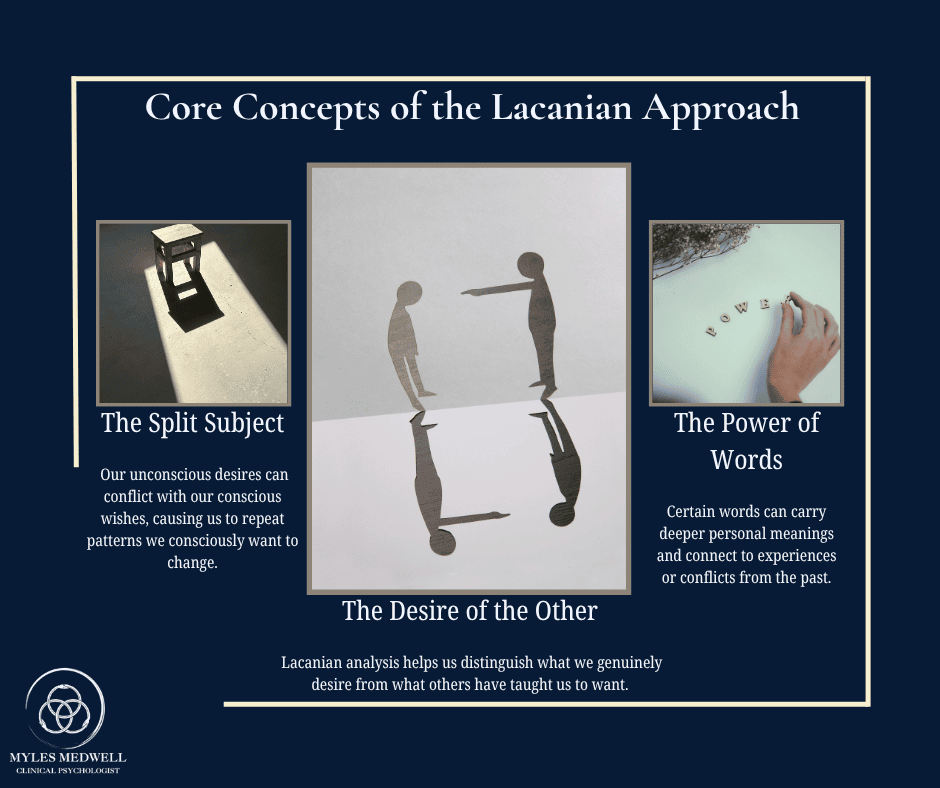
One of Lacan’s most consequential theoretical moves was his account of desire. Need belongs to the biological register, covering food, warmth, and physical proximity. Demand is the articulation of need in language addressed to another. Desire is what remains when need is subtracted from demand, the surplus that language introduces and cannot then discharge. Desire is, structurally, a remainder. It cannot be satisfied, because satisfaction would require an object that does not exist.
The patient who arrives at treatment seeking relief from their symptoms, or hoping to find the relationship that will finally make them feel whole, is seeking an object that will close the gap, that will make good the originary lack that Lacan, following Freud, regards as constitutive of subjectivity itself. Analysis does not promise to fill this gap. It offers instead the possibility of a different relation to it, a less driven, less symptomatic, less compulsive way of inhabiting the fact of one’s desire.
Bruce Fink’s account of the Lacanian subject describes this clearly. The subject is always split, divided between their conscious intentions and the unconscious that runs its own logic beneath them, divided between the identity they present to others and the desire that exceeds and disrupts that presentation (Fink, 1995). That division is the condition of subjectivity as such, not a defect to be corrected.
How the Clinical Work Proceeds
A Lacanian analytic session is structured differently from most other forms of psychological therapy. Its organising principle is free association, the invitation to speak without self-censorship, without editorial selection, without the implicit audience-management that ordinarily governs speech. Most people find this more difficult than it sounds. We are accustomed to presenting ourselves, to constructing a coherent narrative, to saying what we think will be understood or accepted. Free association asks something different, which is to follow the chain of thought wherever it goes, to say the thing that seems irrelevant or embarrassing or too small to mention.
It is in these apparently marginal moments, the slip of the tongue, the dream fragment, the sudden memory with no apparent connection to what was being discussed, that the unconscious speaks most clearly. Freud’s documentation of the psychopathology of everyday life, a systematic study of forgetting, slips, mistakes, and apparently random associations, demonstrated that these failures of ordinary speech are not accidents (Freud, 1901/1960). They have a logic. The task of analytic attention is to begin to hear it.
The analyst’s position in this process is carefully managed. The Lacanian analyst does not offer interpretations in the mode of expert commentary on the patient’s unconscious. They do not advise, reassure, or affirm. They come to occupy the place of what Lacan called the subject supposed to know, the figure to whom the analysand attributes knowledge of their own truth, while working to dissolve that transference rather than sustain it. The analyst’s speech is sparse and precise. The primary technical interventions are a well-placed question, a repetition of the analysand’s own words in a slightly different register, a punctuation of the session at a moment of particular density (Fink, 1997; Lacan, 1958/2006).
The variable-length session, sometimes called the short session or scansion, is a specific Lacanian technical innovation. Rather than ending every session at a fixed clock time, the Lacanian analyst may choose to end the session at a moment of particular resonance. A slip, a significant silence, a phrase that has arrived unexpectedly and deserves time to reverberate. The choice is deliberate, a use of the frame to foreground what has emerged, giving the unconscious material time to work on the analysand between sessions rather than being immediately processed and managed. Lacan articulated the rationale for this in ‘The Direction of the Treatment’ (1958/2006).

Psychoanalysis, Repetition, and the Question of Change
One of the most common questions asked of psychoanalytic treatment is whether it produces change, and if so, of what kind, and on what timescale.
Freud identified the compulsion to repeat as one of the central clinical phenomena of analytic work, the tendency to repeat, in the present, configurations of relationship and experience that originated in the past. The repetition does not bring pleasure. It persists because something in the earlier experience was not worked through, not symbolised, not absorbed into the subject’s history in a way that allowed it to become simply past (Freud, 1914/1958). The repetition is the unconscious’s way of returning to an unfinished problem.
What psychoanalytic treatment offers is not the elimination of this tendency, which is structural, but a gradual change in the subject’s relationship to their own unconscious formations. When a patient begins to recognise their repetitions, not intellectually but in the felt encounter with them as they arise in the transference and in the material of sessions, something shifts. Not a cure in the medical sense, but a loosening, a greater degree of freedom in relation to what had previously been compulsive.
The evidence base for psychoanalytic and psychodynamic treatment is more substantial than is generally acknowledged in mainstream mental health discourse. Shedler’s meta-analysis, published in American Psychologist, found effect sizes for psychodynamic therapy comparable to those reported for other therapies, with a distinctive pattern of continued improvement after treatment ends, a finding rarely observed in briefer, more structured approaches (Shedler, 2010). Fonagy and colleagues’ pragmatic randomised controlled trial of long-term psychoanalytic psychotherapy for treatment-resistant depression found its advantage over treatment as usual emerging most clearly at follow-up rather than at the end of treatment itself (Fonagy et al., 2015). Leichsenring and Leibing’s meta-analysis found psychodynamic therapy effective in the treatment of personality disorders, with outcomes comparable to cognitive behavioural therapy (Leichsenring and Leibing, 2003).
Taken together, these findings suggest that the distinction between depth-oriented and symptom-focused approaches is clinically meaningful and not only a philosophical preference, particularly for presentations characterised by complexity, chronicity, or the failure of briefer interventions.
What Lacanian Psychoanalysis Is Particularly Suited To
Lacanian psychoanalysis is not designed for everyone, and it makes no such claim. It concerns itself with presentations and clinical questions that cannot be adequately addressed through the modification of conscious behaviour or the acquisition of new cognitive skills.
It tends to be of use to people who have accumulated insight, who can articulate their patterns with considerable precision, and who have found that this insight does not produce change. It is often sought by people for whom the recurring difficulty is not a discrete symptom but a more pervasive sense of inhabiting a life that does not quite fit, of wanting something they cannot name, of arriving repeatedly at the same impasse without knowing how they got there again.
It asks something of those who take up the work. Lacanian theory is not intuitive in the way that many contemporary therapeutic frameworks are designed to be. It does not offer a vocabulary of wellness or a set of tools for self-improvement. What it offers is a framework for taking one’s own speech seriously, for beginning to hear what one is actually saying, rather than what one intends to say.
It is also relevant for clinicians and allied health professionals seeking supervision with a psychoanalytic orientation, particularly those who want a framework rigorous enough to match the complexity of the work they are encountering in their own practice.

The Freudian School of Melbourne and the Local Context
In Australia, Lacanian psychoanalysis has been developed and taught primarily through the Freudian School of Melbourne, founded in October 1977 by the Argentine analysts Oscar Zentner and María-Inés Rotmiler de Zentner. It was the first Lacanian psychoanalytic school in the English-speaking world, established outside the International Psychoanalytical Association and with founding statutes modelled on Lacan’s École Freudienne de Paris. The School runs theoretical and reading seminars through the year, publishes the Papers of the Freudian School of Melbourne, begun in 1979 as the first psychoanalytic publication in Australia, and holds an annual conference. Its clinical membership comes from psychiatry, psychology, social work and nursing.
This is the tradition in which my clinical work is grounded. I am a member of the Freudian School of Melbourne, and my practice in Richmond is conducted in accordance with Lacanian principles, which is to say free association as the fundamental rule, careful attention to the specific signifiers that structure each patient’s account of their life, and a commitment to the analytic frame as a space where the patient’s own truth can emerge rather than being prescribed in advance.
Lacanian psychoanalysis in Melbourne remains rare. The number of clinicians working explicitly within this tradition is small. For people searching for this specific approach, particularly those who have found other frameworks insufficient, this matters.
The School’s annual Homage to Lacan is open to the public, and anyone who has read this far and wants to encounter the work directly would be welcome there. This year’s Homage, Cogito Ergo Non Sum, is on Saturday 5 September 2026, 9:30am to 3:00pm, at the Centre for Theology and Ministry, 29 College Crescent, Parkville. It presents the year’s work on Lacan’s Seminar XV, The Psychoanalytic Act, read alongside Jean Allouch and Christian Fierens. Registration is through the School at fsom.org.au.
Anything said here can go only so far. Whoever wants to know something of psychoanalysis will have to read, and to keep reading, and more importantly will have to follow a desire that is their own. There is finally one way of knowing what psychoanalysis is, and it is to undergo an analysis. Psychoanalysis is transmitted rather than taught, and what transmits it is the experience itself.
Sessions are available in person at 53 Erin Street, Richmond, and via Telehealth across Victoria and nationally. I am a registered Clinical Psychologist, and Medicare rebates are available with a Mental Health Care Plan from your GP. A free fifteen-minute phone consultation is available for anyone wanting to understand whether this approach is suited to their situation. There is no obligation.
About Myles Medwell
Myles Medwell is a Clinical Psychologist based in Richmond, Melbourne, whose clinical work is grounded in the Freudian and Lacanian tradition. He holds a Master of Psychology (Clinical) from Federation University and is registered with AHPRA. He is a member of the Australian Clinical Psychology Association and of the Freudian School of Melbourne.
He works with adults and older adolescents across a wide range of presentations, including complex trauma, anxiety, depression, identity and relational difficulties, Functional Neurological Disorder, and personality disorders. GP, psychiatrist, and allied health referrals are welcome.
53 Erin Street, Richmond Melbourne VIC 3121 | www.mylesmedwell.com.au | 0466 509 179
References and Further Reading
Driessen, E., Hegelmaier, L. M., Abbass, A. A., Barber, J. P., Dekker, J. J. M., Van, H. L., Jansma, E. P., and Cuijpers, P. (2015). The efficacy of short-term psychodynamic psychotherapy for depression: A meta-analysis update. Clinical Psychology Review, 42, 1–15.
Fink, B. (1995). The Lacanian Subject: Between Language and Jouissance. Princeton University Press.
Fink, B. (1997). A Clinical Introduction to Lacanian Psychoanalysis: Theory and Technique. Harvard University Press.
Fonagy, P., Rost, F., Carlyle, J., McPherson, S., Thomas, R., Fearon, R. M. P., Goldberg, D., and Taylor, D. (2015). Pragmatic randomized controlled trial of long-term psychoanalytic psychotherapy for treatment-resistant depression: The Tavistock Adult Depression Study. World Psychiatry, 14(3), 312–321.
Freud, S. (1901/1960). The Psychopathology of Everyday Life. In J. Strachey (Ed. & Trans.), The Standard Edition of the Complete Psychological Works of Sigmund Freud, Vol. 6. London: Hogarth Press.
Freud, S. (1914/1958). Remembering, Repeating and Working-Through. In J. Strachey (Ed. & Trans.), The Standard Edition, Vol. 12, pp. 145–156. London: Hogarth Press.
Freud, S. (1915/1957). The Unconscious. In J. Strachey (Ed. & Trans.), The Standard Edition, Vol. 14, pp. 159–215. London: Hogarth Press.
Jakobson, R. (1956). Two Aspects of Language and Two Types of Aphasic Disturbances. In R. Jakobson and M. Halle, Fundamentals of Language, pp. 69–96. The Hague: Mouton.
Lacan, J. (1949/2006). The Mirror Stage as Formative of the I Function. In Écrits: The First Complete Edition in English, translated by B. Fink, pp. 75–81. New York: Norton.
Lacan, J. (1953/2006). The Function and Field of Speech and Language in Psychoanalysis. In Écrits, translated by B. Fink, pp. 197–268. New York: Norton.
Lacan, J. (1957/2006). The Instance of the Letter in the Unconscious, or Reason Since Freud. In Écrits, translated by B. Fink, pp. 412–441. New York: Norton.
Lacan, J. (1958/2006). The Direction of the Treatment and the Principles of Its Power. In Écrits, translated by B. Fink, pp. 489–542. New York: Norton.
Lacan, J. (1964/1981). The Seminar of Jacques Lacan, Book XI: The Four Fundamental Concepts of Psychoanalysis. Translated by A. Sheridan. New York: Norton.
Lacan, J. (1972–73/1998). The Seminar of Jacques Lacan, Book XX: Encore. Translated by B. Fink. New York: Norton.
Laplanche, J., and Pontalis, J.-B. (1973). The Language of Psycho-Analysis. Translated by D. Nicholson-Smith. London: Hogarth Press.
Leader, D. (2011). What Is Madness? London: Hamish Hamilton.
Leichsenring, F., and Leibing, E. (2003). The effectiveness of psychodynamic therapy and cognitive behavior therapy in the treatment of personality disorders: A meta-analysis. American Journal of Psychiatry, 160(7), 1223–1232.
Saussure, F. de (1916/1983). Course in General Linguistics. Translated by R. Harris. London: Duckworth.
Shedler, J. (2010). The efficacy of psychodynamic psychotherapy. American Psychologist, 65(2), 98–109.
Soler, C. (2014). Lacan: The Unconscious Reinvented. Translated by E. Faye and S. Schwartz. London: Routledge.