Two Different Questions About the Same Suffering
That difference is often treated as a controversy, though it need not be. The debate between the psychoanalytic and cognitive-behavioural traditions has generated more heat than light, and much of it has been the two sides talking past each other. What gets lost is the simpler point that each framework was built for something different and rests on its own assumptions about what suffering is. Those assumptions deserve an honest look rather than being smoothed over in the name of therapeutic pluralism, and the place to start is CBT, since it is the approach most people have already met.
What CBT Is, and What It Is Built For
Cognitive Behavioural Therapy as most people know it came out of Aaron Beck’s work on depression in the 1960s and 1970s (Beck, 1979). Its central claim is that psychological distress is largely maintained by patterns of thinking that are negative, distorted or poorly calibrated to reality. CBT sets out to identify these patterns, test them and replace them with more accurate or functional alternatives, and in doing so to relieve the distress they produce.
The method was later carried beyond depression to anxiety disorders, obsessive-compulsive presentations and a range of other conditions, and over several decades it has built an impressive evidence base (Clark and Beck, 2010). CBT tends to be structured, time-limited and goal-directed, and it can be delivered in much the same way by different clinicians. That suits it to randomised controlled trials, which is one reason it became the dominant psychological treatment in publicly funded health systems across the English-speaking world.
That dominance is not unearned. For many people with a discrete anxiety problem, or a depressive episode without longstanding complexity, CBT offers real and lasting benefit, and for others it brings meaningful relief from symptoms within a manageable timeframe. Its structure also makes it far easier to study than longer, less defined approaches. I have no quarrel with any of this, and the trouble only starts at the edges of what CBT was designed to do.
Where CBT Runs Out
At those edges the model’s assumptions start to show. Most structured cognitive-behavioural protocols assume that what keeps distress going is primarily conscious, identifiable and modifiable through deliberate reflection. The task of therapy, on this model, is to help the person notice what they are thinking, weigh whether those thoughts are accurate or helpful, and practise thinking differently.
Practising thinking differently works when the problem really is a problem of conscious thought. It works less well when what keeps the distress going is not primarily conscious or cognitive, and so cannot be reached by reflecting on it. That is the situation of many of the people who come to see me, particularly those with complex presentations, longstanding patterns or a history of relational trauma.
Even with depression, where CBT began, the evidence is less tidy than it is often made to look. Cuijpers and colleagues, in large meta-analytic reviews of CBT for depression, found that effect sizes, while still meaningful, shrink considerably once studies at high risk of bias are excluded, and that relapse at long-term follow-up is common (Cuijpers et al., 2019). Wampold’s analysis of psychotherapy outcome data found that the specific techniques of a therapy, CBT included, account for far less of the variation in outcomes than is usually assumed, and that the therapeutic relationship and other common factors play a consistently larger part (Wampold, 2001).
If the relationship is doing more of the work than the technique, then what helps in CBT may not be what CBT’s theory says should help. The engagement, and the sense that something is being attended to, may count for more than any exercise. And when the person’s difficulty plays out in relationships, the therapeutic one included, that raises the question of what kind of treatment is likely to help.
What Psychoanalysis Asks Instead
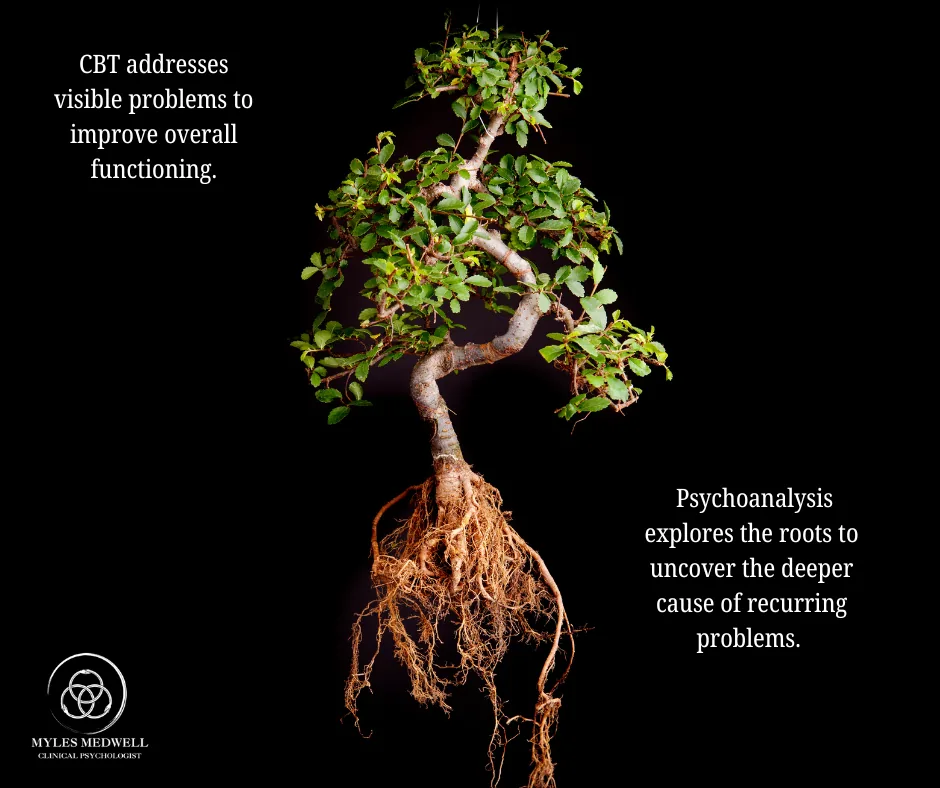
Psychoanalysis starts from a different premise about what such a difficulty is. Its founding observation, made by Freud in the 1890s and developed across more than a century of clinical and theoretical work, is that psychological suffering is largely organised by unconscious processes. These cannot be reached by deliberate reflection or corrected with information and reframing, and they are not simply the product of inaccurate thinking. A symptom, on this view, is not a mistake but a formation, something constructed, often with considerable ingenuity, to manage what cannot yet be managed any other way.
That ingenuity is unconscious, and the unconscious, for Freud, was less a hiding place for thoughts than a structure with laws of its own. It takes no account of time or contradiction, the rules that order conscious life (Freud, 1915/1957). It repeats what it cannot remember. It speaks through the body, in dreams and slips of the tongue, in what is said without being meant and in what cannot quite be said at all.
Lacan took up this question of what can and cannot be said, and from the early 1950s his seminars sharpened and radicalised Freud’s claim. The unconscious, he argued, is structured like a language. It works through metaphor and metonymy, which Lacan, following Jakobson, found at work in what Freud had called condensation and displacement, and through the sliding of meaning beneath words that seem fixed (Lacan, 1957/2006). What a person actually says, the particular signifiers they use and keep returning to, the places where their speech hesitates or contradicts itself, is not secondary to what they mean. It is often closer to what the unconscious is doing than the intended meaning ever was.
If the difficulty is organised there, then interventions aimed at conscious thinking will at best rearrange what a person thinks and leave untouched the structure the symptom belongs to. The pattern returns, and insight, however hard-won, does not translate into change. People often describe exactly this when they first come to see me, finding themselves back in the same place despite everything they have understood, and it is usually this that has brought them, eventually, to psychoanalytic work.
Two Different Models of Change
Psychoanalytic work also rests on a different idea of change. CBT and psychoanalysis differ on what distress is, and they differ just as much on what change means and how it comes about.
In CBT, change comes about through modifying maladaptive patterns of thought and behaviour. The target can be identified and the direction is set in advance, from distorted thinking towards more accurate thinking, or from avoidance towards approach. Progress is measured against those targets, and treatment reaches its natural end when they are met.
Psychoanalysis sets no such target in advance. Change here is less a movement from a wrong position to a correct one than a loosening of the hold that unconscious formations have had on someone’s life, without their knowledge or consent. What shifts is their relation to their own desire, and to the unconscious that has been speaking through them. This is harder to measure and slower to arrive, and it does not sit easily with endpoints fixed at the outset.
Some of it can still be measured, and what has been measured suggests that these changes last. In the Tavistock Adult Depression Study, Fonagy and colleagues ran a randomised controlled trial of long-term psychoanalytic psychotherapy with people whose depression had not responded to at least two earlier treatments. The difference between the psychoanalytic group and the group that received only treatment as usual became clear after treatment had ended, and it widened over the follow-up years (Fonagy et al., 2015).
A trial that stopped measuring at the end of treatment would have missed this, as the authors themselves point out, and it is not the pattern usually seen with shorter, more structured approaches, where gains often plateau and sometimes reverse. De Maat and colleagues, reviewing studies of long-term psychoanalytic therapy, found substantial effects on symptoms and broader functioning that held well after treatment had finished (de Maat et al., 2009).
Research like this is often lumped in with studies of psychodynamic therapy, but psychodynamic therapy is a different treatment. It developed within psychiatry, drawing on ego psychology and object relations, and its results cannot simply be carried over to psychoanalysis.
The research does not always keep that line itself. The Tavistock treatment comes out of the British tradition associated with Melanie Klein and object relations rather than the Lacanian one, and when the team checked what their therapists were doing, they measured it against a psychodynamic model. Even this trial, then, tells us less about Lacanian psychoanalysis than its name suggests.
Read alongside de Maat’s review, it still suggests that the two approaches are working towards different kinds of change. That does not make psychoanalysis better than CBT across the board, but where the change that matters is structural rather than symptomatic, the longer work of psychoanalysis can shift what shorter approaches leave in place.
On the Question of Time
Longer-term work brings with it the most common objection to psychoanalysis, and in some respects the most reasonable one. It takes too long. In a health system built around brief interventions and a set number of sessions, a treatment that may run for years is hard to justify and hard to fund, and for many people it is out of reach.
That is a real problem and I will not pretend otherwise. Access to long-term psychological treatment is inequitably distributed, and many people who would benefit cannot get it through the public system or afford it privately.
Cost is one thing, but the argument about time often hides a sleight of hand. It sets a brief course of CBT that relieves symptoms in the short term against a long psychoanalytic treatment that is slower to show its effects, and declares the brief course more efficient without asking what happens over the longer trajectory. Someone who completes a twelve-session CBT protocol for depression, relapses within eighteen months, does a second course and goes on cycling through treatment for a decade has not been helped efficiently so much as managed, over and over. Which approach is more efficient with time depends on the timeframe, and the timeframe you choose largely decides the answer.
It also depends on who is coming to treatment. Someone with a circumscribed difficulty, a capacity for insight and a reasonably stable life may do well in a shorter treatment, and CBT may be all they need. Where the difficulties are complex, chronic and tied up with relationships, or shorter treatments have already been tried without lasting effect, the case for psychoanalytic work becomes much stronger.
Side by Side
Put in a table, the differences look something like this. It is a simplification offered for orientation, and every entry deserves more nuance than a table cell can give.
| CBT | Psychoanalytic Therapy |
Primary focus | Conscious thoughts, feelings, and behaviours | Unconscious structure, patterns of repetition, desire |
Theory of suffering | Maintained by maladaptive thoughts and behaviours | Organised by unconscious processes; symptom as formation |
Role of therapist | Active, directive, psychoeducational | Non-directive, holds a listening position |
Session structure | Set agenda, homework, and exercises | Free association; no fixed agenda |
Duration | Usually fewer than 10 sessions | Usually years |
Goal | Symptom reduction and new skills | A structural shift in one’s relation to the unconscious |
Treatment completion | A defined endpoint once goals are reached | Open-ended and concluded by the subject |
Evidence base | Strong, especially for discrete presentations | Growing, especially for complex and long-term presentations |
After-treatment effects | Gains often hold, with more relapse in complex presentations | Benefits can emerge or grow after treatment ends |
When Someone Has Already Tried CBT
No table settles a question that comes up regularly in my practice. What do you offer someone who has already done CBT, found it helpful but not transformative, and arrived wondering whether something else is available?
What I tell them is not that psychoanalysis is better than CBT, but that it asks a different question, and that this question may be the one that fits where they find themselves now.
CBT’s question was what thoughts are maintaining the distress and whether they can be modified. That question may well have been answered, at least in part. The person may have learned to notice their negative automatic thoughts, to challenge their catastrophising and to act differently in situations they used to avoid, and some of that learning will have been useful.
Useful as it is, that learning does not ask what the symptom is saying, which is where psychoanalysis begins. What is this particular difficulty doing in this person’s life, at this point and in this form? What is being repeated, and what does the repetition keep returning to? What cannot yet be said?
Questions like these are not better in the abstract, and they are not for everyone. They come into their own when a difficulty persists despite real engagement with shorter approaches, or when insight piles up without anything changing and the person keeps arriving back at the same place.
What the Evidence Can and Cannot Tell Us
That kind of return is hard to put a number on, which brings me to the evidence. The research base for psychological therapy has grown a great deal over the past three decades, and that is mostly a good thing. We know more than we did about what works, for whom and under what conditions, and systematic reviews and meta-analyses have made it harder to sustain claims that rest only on clinical tradition or theoretical elegance.
Rigour has its blind spots all the same. Randomised controlled trials of psychological therapy tend to measure symptom reduction over a defined treatment period, using standardised instruments that capture what can be operationalised. They struggle to register a person’s relation to their own desire, how far they are still governed by unconscious repetition, or a change in how they inhabit their own history. Those are the outcomes psychoanalytic treatment is most concerned with, and they are the ones symptom-rating scales are least equipped to measure.
None of this places psychoanalytic treatment beyond the reach of evidence, and the studies cited here show real and measurable effects. The metrics that dominate the outcomes literature capture only part of what psychoanalytic work sets out to do, and they were never designed to assess structural change in the psychoanalytic sense.
Even on measures that were not built for it, psychoanalytic treatment produces substantial and durable effects, and at long-term follow-up it has done better than the treatment people would otherwise have received. For people with complex presentations, where what keeps the suffering going is not primarily cognitive and the timeframe is not a matter of weeks, the case for psychoanalytic work is well supported by the evidence, before its theoretical coherence even comes into it.
That theory informs the Lacanian psychoanalytic approach I take at Myles Medwell Psychology, where I see adults and older adolescents. Sessions are available in person at 53 Erin Street, Richmond, and by telehealth across Victoria. I am a registered Clinical Psychologist, and Medicare rebates are available with a Mental Health Care Plan from your GP. If you would like to talk through whether psychoanalytic work suits where you find yourself now, I offer a free fifteen-minute phone consultation.
About Myles Medwell
Myles Medwell is a Clinical Psychologist in Richmond, Melbourne, whose work is grounded in Freudian and Lacanian psychoanalysis. He holds a Master of Psychology (Clinical) from Federation University and is registered with AHPRA. He is a member of the Australian Clinical Psychology Association and of the Freudian School of Melbourne.
He works with adults and older adolescents presenting with complex trauma, anxiety and depression, personality disorders, identity and relational difficulties, Functional Neurological Disorder and dissociative presentations. Psychological assessment and psychoanalytic clinical supervision are also available.
Level 1, 53 Erin Street, Richmond VIC 3121 · mylesmedwell.com.au · 0466 509 179
References
Beck, A. T. Cognitive Therapy of Depression. New York: Guilford Press. (1979)
Clark, D. A., and Beck, A. T. Cognitive Therapy of Anxiety Disorders: Science and Practice. New York: Guilford Press. (2010)
Cuijpers, P., Karyotaki, E., Weitz, E., Andersson, G., Hollon, S. D., and van Straten, A. The effects of psychotherapies for major depression in adults on remission, recovery and improvement: A meta-analysis. Journal of Affective Disorders, 202, 511-519. (2019)
de Maat, S., de Jonghe, F., Schoevers, R., and Dekker, J. The effectiveness of long-term psychoanalytic therapy: A systematic review of empirical studies. Harvard Review of Psychiatry, 17(1), 1-23. (2009)
Fonagy, P., Rost, H., Carlyle, J., McPherson, S., Thomas, R., Fearon, R. M. P., Goldberg, D., and Taylor, N. Pragmatic randomized controlled trial of long-term psychoanalytic psychotherapy for treatment-resistant depression. World Psychiatry, 14(3), 312-321. (2015)
Freud, S. The Unconscious. In J. Strachey (Ed. and Trans.), The Standard Edition of the Complete Psychological Works of Sigmund Freud, Vol. 14, pp. 159-215. London: Hogarth Press. (Original work published 1915; SE 1957)
Freud, S. Remembering, Repeating and Working-Through. In J. Strachey (Ed. and Trans.), The Standard Edition, Vol. 12, pp. 145-156. London: Hogarth Press. (Original work published 1914; SE 1958)
Lacan, J. The Instance of the Letter in the Unconscious, or Reason Since Freud. In Ecrits: The First Complete Edition in English, translated by B. Fink, pp. 412-441. New York: Norton. (Original work published 1957; English translation 2006)
Lacan, J. The Seminar of Jacques Lacan, Book XI: The Four Fundamental Concepts of Psychoanalysis. Translated by A. Sheridan. New York: Norton. (Original seminars 1964; English translation 1981)
Leichsenring, F., and Leibing, E. The effectiveness of psychodynamic therapy and cognitive behavior therapy in the treatment of personality disorders: A meta-analysis. American Journal of Psychiatry, 160(7), 1223-1232. (2003)
Malan, D. H. The Frontier of Brief Psychotherapy: An Example of the Convergence of Research and Clinical Practice. New York: Plenum Press. (1976)
Shedler, J. The efficacy of psychodynamic psychotherapy. American Psychologist, 65(2), 98-109. (2010)
Wampold, B. E. The Great Psychotherapy Debate: Models, Methods, and Findings. Mahwah, NJ: Lawrence Erlbaum Associates. (2001)