
Repression of the Signifier: Why Catharsis Fails | Myles Medwell
Introduction: The Misreading of Freud
Freud is frequently mischaracterised in popular psychology as an advocate of emotional venting or catharsis. It is a view that conceptualises the psyche as akin to a pressurised vessel, with psychological well-being dependent on the periodic release of repressed affect (see Breuer & Freud, 1895/2001). This model underpins widespread therapeutic practices oriented around emotional discharge, such as primal therapy and various forms of somatic release (cf. Alexander, 1950). However, this interpretation oversimplifies Freud’s metapsychological writings and neglects the organisational intricacy of psychic conflict elucidated in psychoanalytic theory.
This is not Freud’s position.
Freud’s metapsychology is notably more rigorous and more sophisticated than the cathartic model suggests. In “The Unconscious” (1915), as well as in “Repression” (1915) and “Inhibitions, Symptoms and Anxiety” (1926), Freud contends that repression operates primarily on the level of representations (Vorstellungen) (the ideational content or thoughts associated with a wish) rather than on affect itself (Freud, 1915a, 1915b, 1926/1959). Affects, according to Freud, are subject to processes of displacement and transformation; they may be converted into somatic symptoms or manifest in distorted forms, but they are not ‘repressed’ in the same manner as the associated ideas. The unconscious, therefore, is not simply a repository of “unfelt feelings” but instead a dynamic system of thoughts and representations that are structurally excluded from conscious acknowledgement due to their incompatibility with the ego’s self-image (Laplanche & Pontalis, 1973).

Lacan further develops and radicalises Freud’s conceptualisation of repression, particularly in Seminar XI (Lacan, 1977), “The Instance of the Letter in the Unconscious” (1957), and “The Direction of the Treatment” (1958). For Lacan, repression concerns the exclusion of a signifier, that is an element of language or meaning, that cannot be assimilated into the subject’s symbolic order (Lacan, 1977, 2006). The repressed signifier constitutes a gap in the subject’s narrative coherence. Affect, in this schema, appears not as a repressed entity but as a residue or trace (“that which leaks around the edges,” so to speak), manifesting in instances such as anxiety, shame, and somatic symptoms (Leader, 2011; Laplanche & Pontalis, 1973). As Laplanche and Pontalis emphasise in The Language of Psycho-Analysis, repression always concerns a representation, and the libidinal energy attached to that representation is redirected or displaced within the psyche.
Clinical psychoanalytic experience, as described by Freud (1915a, 1926/1959) and expanded upon by contemporary analysts regularly shows that patients are not, as is often supposed, alienated from their affective states. On the contrary, many individuals present with intense, unmediated emotions. For example people enter the clinic and they may cry readily, experience profound internal rage, or articulate in detail their experiences of dread and despair. Despite this acute proximity to affect, the symptom persists and so panic recurs, compulsive patterns reassert themselves, and the body somatises psychic conflict. This clinical pattern accentuates the inadequacy of explanatory models based solely on affective repression or emotional suppression (Freud, 1915a; Laplanche & Pontalis, 1973).
The central difficulty, as theorised by Freud and subsequently by Lacan (Lacan, 1977), does not lie in a deficit of feeling per se, but in the disjunction between affect and its corresponding representation or signifier. In psychoanalytic terms, the affect is severed from the ideational content to which it was originally bound, resulting in a circulating or free-floating affect that lacks symbolic articulation.
Repression: What Goes Under, What Comes Back
Freud’s early collaboration with Josef Breuer in Studies on Hysteria (Breuer & Freud, 1895/2001) shows a transitional stage in the development of psychoanalytic theory, still defined by vestiges of the “pressure” or hydraulic model of affect. Nevertheless, even in these foundational case studies, Freud observes that affect may find expression through hysterical conversion symptoms. E.g paralysis, pain, or seizure. While the precipitating scene or idea remains inaccessible to consciousness. By the publication of “The Unconscious” and “Repression” in 1915, Freud’s position is unambiguous. It is not affect that is repressed, but rather the representation (Vorstellung), the ideational content associated with conflict (Freud, 1915a, 1915b). When an event, desire, or thought fundamentally conflicts with a person’s moral image of themselves, or with the demands of their environment, a split occurs. The representation such as “I wanted her gone,” “I felt relief when he died,” “I enjoyed what I was not supposed to enjoy” – becomes intolerable. It is pushed out of conscious thought. The affect that belonged to that representation is cut loose. It detaches and begins to circulate.
Lacan (1977) reformulates this Freudian insight by claiming that what is excluded from the subject’s symbolic order is the signifier, the fundamental unit of linguistic meaning, rather than a generic affect. This foreclosure or radical repression of the signifier renders the corresponding affect unanchored, resulting in its manifestation as anxiety, inhibition, agitation, or somatic disturbance (Lacan, 1977; Leader, 2011).
Leader’s (2011) clinical research on anxiety and psychosomatic phenomena illustrates that individuals may offer comprehensive accounts of their affective conditions yet remain unable to specify the underlying ideational locus of their affect. Thus, the conceptual framework accounts for the apparently ‘contextless’ emergence of anxiety. Such examples include instances like panic attacks on public transport, inexplicable anxiety in mundane settings, or somatic responses in innocuous contexts. In such cases, the immediate situation rarely constitutes the true object of anxiety. Rather, as Freud (1899/1954) describes in his analysis of screen memories, these scenarios function as façade scenes. That is, they displace or stand in for an unconscious conflict or representation that remains inaccessible to the subject’s awareness.
Anxiety, Phobia, and the Speaking Body
In “Inhibitions, Symptoms and Anxiety” (Freud, 1926/1959), Freud moves beyond his earlier conceptualisation of anxiety as a mere consequence of libidinal blockage. He reconceptualises anxiety as a complex psychic signal, a reaction to expected danger linked to separation, castration, loss of love, or the resurgence of repressed content (Freud, 1926/1959; Rycroft, 1995). Lacan extends Freud’s work in “Seminar X: Anxiety” (Lacan, 2014), arguing that anxiety is always related to an object, albeit one that is not readily accessible to conscious identification. The object of anxiety, Lacan contends, is frequently misattributed or remains enigmatic, representing the subject’s inability to locate the precise signifier for their distress (Fink, 1997; Leader, 2011).
In many clinical presentations, anxiety is experienced as diffuse and free-floating, lacking a clear situational anchor. Such phenomena are commonly diagnosed as Generalised Anxiety Disorder for instance (American Psychiatric Association, 2013). From a psychoanalytic perspective, however, such anxiety is better understood as a persistent signal of danger whose source is repressed or unarticulated (Freud, 1926/1959; Laplanche & Pontalis, 1973). The signifiers that would allow the subject to identify and symbolise the source of anxiety are foreclosed or repressed, leading the body to express what cannot be articulated in language (McDougall, 1989; Green, 1999).
In other cases, the psyche attempts to manage anxiety by localising it onto a specific object, resulting in the formation of a phobia. Freud’s analysis of Little Hans (Freud, 1909/1955) illustrates this mechanism. The phobic object (the horse) serves as a displaced focus for more pervasive, unformulated fears tied to oedipal dynamics, which, for Hans, were, namely, paternal authority, maternal desire, and the child’s own libidinal position within the familial structure (Freud, 1909/1955; Laplanche & Pontalis, 1973). Lacan’s reading in “Seminar IV” (Lacan, 1998) further explains how the phobia functions as a provisional solution, structuring fear around an externalisable object so that the subject may temporarily avoid direct confrontation with unconscious conflicts (Fink, 1997; Leader, 2011).
When a repressed representation fails to achieve any symbolic articulation, its associated affect may be somatised, ‘converted’ into bodily symptoms. While the classical hysterical paralyses and conversion disorders described by Freud (Breuer & Freud, 1895/2001) are still prevalent today, contemporary equivalents appear as Functional Neurological Disorder, psychogenic non-epileptic seizures, chronic pain syndromes without identifiable organic cause, and idiopathic states of fatigue (Stone et al., 2005; Kozlowska et al., 2015). André Green (1999) and Joyce McDougall (1989) have theorised these manifestations as “psychosomatic organisations,” wherein the body inscribes and expresses psychic conflict that cannot be represented in language. The symptom thus operates as a hieroglyph of sorts. A corporeal script for an unconscious drama that remains unspeakable (Laplanche & Pontalis, 1973).
Across these clinical configurations, the core issue is not a deficit of emotional experience, but rather the structural dissociation between affect and the repressed representation to which it belongs (Freud, 1915a; Green, 1999; Laplanche & Pontalis, 1973). What is felt remains unintegrated precisely because it cannot be consciously associated with the underlying, unacknowledged thought or signifier.
Why Catharsis Is Not Enough
Freud’s eventual rejection of the cathartic method was grounded in his clinical observation that, although hypnosis could facilitate the discharge of affective tension, appearing as tears, bodily tremors, or episodic anguish, such relief was only transient (Freud, 1914/1958, 1926/1959). Symptoms tended to recur or be replaced by others, suggesting that it was not the intensity of emotional release that effected lasting change, but rather the articulation and conscious integration of the repressed representation (Breuer & Freud, 1895/2001; Laplanche & Pontalis, 1973).
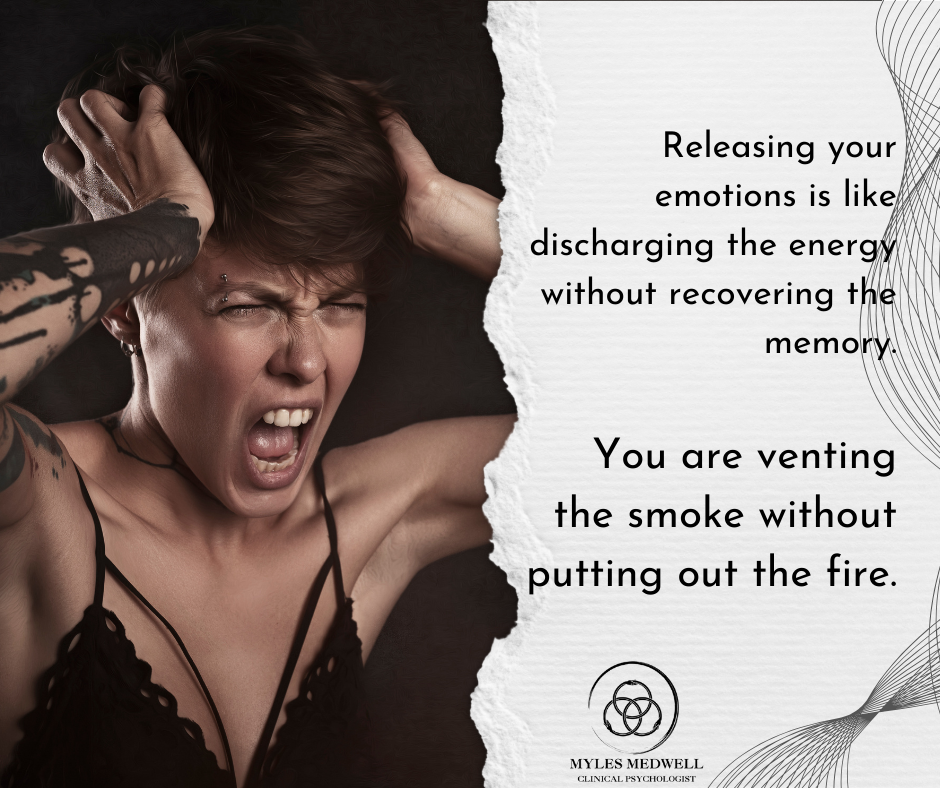
Freud elaborates in “The Unconscious” (1915a) and the “Introductory Lectures on Psycho-Analysis” (Freud, 1916-1917/1966) that repression can only be resolved when the repressed representation is replaced or rearticulated by another representation that can be consciously acknowledged. Emotional catharsis, in isolation, is insufficient to dissolve repression. Therefore, for the psychoanalyst, therapeutic progress requires the subject to verbalise the previously unthinkable thought; until this occurs, the symptom continues as a proxy or substitute for the unvoiced idea (Laplanche & Pontalis, 1973; Fink, 1997).
Consequently, therapeutic modalities that focus exclusively on emotional release, such as somatic, EMDR or experiential therapies, might provide short-term alleviation yet often fail to effect structural transformation (Freud, 1914/1958; McDougall, 1989). Individuals may engage in dramatic expressions of affect without ever addressing the symbolic knots at the locus of their desire. Lacan, in “The Direction of the Treatment and the Principles of its Power” (Lacan, 1958/2006), sharply critiques such “imaginary” therapies for privileging experiential relief over the symbolic reorganisation of the subject’s psychic structure (Fink, 1997).
Enduring therapeutic change in psychoanalysis is more often catalysed by the articulation of a previously repressed thought within the analytic context rather than by the experience of emotional discharge (Freud, 1915a; Fink, 1997; Leader, 2011). The emergence of a simple, yet unspeakable utterance such as “I wanted her to fail” or “I felt relieved when he left”, in a transferentially dramatic moment, can markedly reduce the apprehension that had been serving to defend against that particular thought. In such instances, the affect is no longer unmoored; it is symbolically anchored through speech (Lacan, 2006; McDougall, 1989).
Screen Memories. How We Misremember Ourselves
Freud’s essay “Screen Memories” (Freud, 1899/1954) offers a subtle account of the interplay between memory and repression. He observes that individuals often retain exceptionally vivid recollections of seemingly trivial childhood events—a patch of yellow flowers, a corner of a garden, or a minor quarrel. Freud argues that the memorability of such insignificant scenes is not coincidental. Rather, these memories function as “screens” that obscure more significant, repressed material. Importantly, Freud notes that what is screened is not necessarily a direct traumatic event; instead, it may relate to unconscious fantasies, including those surrounding the so-called “primal scene”—the child’s imagined or fantasised encounter with parental sexuality (Freud, 1899/1954; Laplanche & Pontalis, 1973).

Building on Freud, later theorists such as Laplanche and Lacan have emphasised that the screen memory often covers not an actual event, but a fantasmatic structure—what Lacan terms the “fantasm”—that organises the subject’s relation to desire and knowledge (Lacan, 2006; Laplanche, 1999). In this sense, the screen memory operates as a compromise formation: it represents a disguised way of maintaining proximity to an unconscious fantasy that cannot be directly acknowledged. Thus, the significance of the screen memory lies less in the content of the recalled scene itself than in its structural function within the subject’s psychic economy (Laplanche & Pontalis, 1973; Rycroft, 1995).
Thus, in the psychoanalytic clinic, memories are not approached as simple information to be retrieved and catalogued; rather, they are interpreted as texts, subject to hermeneutic analysis (Freud, 1914/1958; Laplanche & Pontalis, 1973). The analyst seeks to discern why a particular memory has been preserved in a given form, what latent content lies at its margins, and what omissions or distortions structure the patient’s habitual narrative (Rycroft, 1995; Leader, 2011).
Therefore, analysis takes time because we are not downloading a hard drive. We are following the distortions through which the unconscious writes itself.
What Actually Happens in an Analytic Session
If the analytic process is not simply a matter of emotional catharsis or “letting off steam,” what, then, constitutes its core activity? As Freud established in his early technical writings (Freud, 1912/1958; 1913/1958), and as Lacan later elaborated (Lacan, 1953/2006), the analytic setting is structured around the production of speech under the rule of free association, inviting the subject to articulate what would otherwise stay unexpressed.
Freud formulated the “fundamental rule” of psychoanalysis. This is that the analysand should say everything that comes to mind, without censorship or selection (Freud, 1912/1958). Lacan (1953/2006) emphasises that this does not entail narrating one’s life story in a linear or logical manner. Rather, it entails permitting speech to emerge precisely at those points where self-editing, apology, or silence might ordinarily intervene. It is in the lapsus, contradiction, or seemingly irrelevant association the points at which language falters, that the unconscious manifests itself (Lacan, 1953/2006; Leader, 2011).
Through the sustained practice of free association, the “chain of signifiers” (Lacan, 1977) is gradually displaced, enabling previously repressed words and ideas to surface. The analyst’s task, as described by Freud (1912/1958) and Lacan (1953/2006), is not simply to attend to the manifest content of speech, but to detect ruptures in the signifying chain where moments where affect attaches to apparently innocuous utterances, or where certain images and motifs recur and serve to organise the subject’s psychic reality (Laplanche & Pontalis, 1973).
Patients commonly initiate analysis with a symptomatic complaint such as anxiety, insomnia, repetitive relational failures, or psychosomatic disturbances (Freud, 1917/1966). The analytic process gradually shifts this focus from the articulation of complaint to the posing of questions: What patterns am I unconsciously repeating? What position do I occupy within these recurring scenarios? What is my desire, beyond its conscious articulation? (Lacan, 2006; Green, 1999).
According to Lacan (2006), the subject’s analytic trajectory involves a shift from experiencing oneself as a passive victim of symptoms to assuming an active stance toward one’s unconscious desire. This stance does not entail attributing blame to the analysand for their suffering; rather, it recognises the symptom as a compromise formation, or a “solution,” albeit a painful one, to an unresolved psychic conflict (Freud, 1926/1959; Laplanche & Pontalis, 1973).
From Living Indirectly to Speaking Otherwise
From a metapsychological perspective, what resurfaces in analytic work is not simply “buried emotion,” yet undergoes that have been lived indirectly organised around repressed representations (Freud, 1915a; Laplanche & Pontalis, 1973). This conception is indebted to Freud’s theory of repression and to Lacan’s proposition that “the unconscious is structured like a language” (Lacan, 1977).
When representations are repressed, the subject’s life becomes structured around them in displaced or disguised forms (Freud, 1915a; Green, 1999). For example, individuals might unknowingly select partners who repeat aspects of their primary relational scenes, or enter into work environments that recapitulate earlier demands. Somatic symptoms may emerge as embodied responses to unsettled psychic questions. André Green’s (1999) concept of the “dead mother” powerfully illustrates how unprocessed loss can permeate the psychic field without ever being consciously recognised or symbolised.
In this sense, symptoms are not simply passive afflictions but are inhabited by the subject; they become the modalities through which an unarticulated psychic truth is lived out (Freud, 1915a; McDougall, 1989; Leader, 2011).
The aim of psychoanalytic work is not to intensify emotional expression, but to facilitate the emergence of excluded signifiers into speech, thereby allowing affect to be anchored and symbolised (Lacan, 1977; Fink, 1997). This procedure unfolds slowly and is better characterised as a transformation of the subject’s relation to their history, rather than a medical cure (Laplanche & Pontalis, 1973).

Psychoanalysis does not promise unbroken happiness or emotional equilibrium (Freud, 1930/1961). Rather, it offers the possibility that the subject may come to be less governed by what has remained unspoken, thereby enabling a less indirect engagement with one’s own desire and history (Lacan, 2006; Leader, 2011).
If, after years of affective work and emotional catharsis, a persistent sense of impasse remains, psychoanalytic theory suggests that the issue may not be an insufficiency of feeling but a failure in symbolic articulation (Freud, 1915a; Fink, 1997). It is at this juncture that the analytic process properly commences.
Myles Medwell
Clinical Psychologist and Psychoanalytic Practitioner
Richmond, Melbourne
If you would like to explore this kind of work, you are welcome to make contact.
Primary Sources
- Freud, S. (1899/1954). Screen Memories. In J. Strachey (Ed. & Trans.), The Standard Edition of the Complete Psychological Works of Sigmund Freud (Vol. 3, pp. 303–322). London: Hogarth Press. (Original work published 1899)
- Freud, S. (1909/1955). Analysis of a Phobia in a Five-Year-Old Boy (“Little Hans”). In J. Strachey (Ed. & Trans.), The Standard Edition (Vol. 10, pp. 1–149). London: Hogarth Press.
- Freud, S. (1912/1958). Recommendations to Physicians Practising Psycho-Analysis. In J. Strachey (Ed. & Trans.), The Standard Edition (Vol. 12, pp. 109–120). London: Hogarth Press.
- Freud, S. (1913/1958). On Beginning the Treatment. In J. Strachey (Ed. & Trans.), The Standard Edition (Vol. 12, pp. 121–144). London: Hogarth Press.
- Freud, S. (1914/1958). Remembering, Repeating and Working-Through. In J. Strachey (Ed. & Trans.), The Standard Edition (Vol. 12, pp. 145–156). London: Hogarth Press.
- Freud, S. (1915a/1957). The Unconscious. In J. Strachey (Ed. & Trans.), The Standard Edition (Vol. 14, pp. 159–215). London: Hogarth Press.
- Freud, S. (1915b/1957). Repression. In J. Strachey (Ed. & Trans.), The Standard Edition (Vol. 14, pp. 141–158). London: Hogarth Press.
- Freud, S. (1916-1917/1966). Introductory Lectures on Psycho-Analysis. In J. Strachey (Ed. & Trans.), The Standard Edition (Vol. 15–16). London: Hogarth Press.
- Freud, S. (1926/1959). Inhibitions, Symptoms and Anxiety. In J. Strachey (Ed. & Trans.), The Standard Edition (Vol. 20, pp. 77–175). London: Hogarth Press.
- Freud, S. (1930/1961). Civilization and Its Discontents. In J. Strachey (Ed. & Trans.), The Standard Edition (Vol. 21, pp. 57–145). London: Hogarth Press.
- Breuer, J., & Freud, S. (1895/2001). Studies on Hysteria. In J. Strachey (Ed. & Trans.), The Standard Edition (Vol. 2, pp. 1–305). London: Vintage.
Lacanian Texts
- Lacan, J. (1953/2006). The Function and Field of Speech and Language in Psychoanalysis. In Écrits (B. Fink, Trans., pp. 197–268). New York: Norton.
- Lacan, J. (1957/2006). The Instance of the Letter in the Unconscious. In Écrits (B. Fink, Trans., pp. 412–441). New York: Norton.
- Lacan, J. (1958/2006). The Direction of the Treatment and the Principles of Its Power. In Écrits (B. Fink, Trans., pp. 489–542). New York: Norton.
- Lacan, J. (1977). The Four Fundamental Concepts of Psychoanalysis (Seminar XI) (A. Sheridan, Trans.). London: Hogarth Press.
- Lacan, J. (1998). The Seminar of Jacques Lacan, Book IV: The Object Relation (J.-A. Miller, Ed.; C. Gallagher, Trans.). New York: Norton.
- Lacan, J. (2006). Écrits: The First Complete Edition in English (B. Fink, Trans.). New York: Norton.
- Lacan, J. (2014). The Seminar of Jacques Lacan, Book X: Anxiety (A. R. Price, Trans.). Cambridge: Polity Press.
Secondary and Contemporary Sources
- Alexander, F. (1950). Psychosomatic Medicine: Its Principles and Applications. New York: Norton.
- American Psychiatric Association. (2013). Diagnostic and Statistical Manual of Mental Disorders (5th ed.). Arlington, VA: American Psychiatric Publishing.
- Fink, B. (1997). A Clinical Introduction to Lacanian Psychoanalysis: Theory and Technique. Cambridge, MA: Harvard University Press.
- Green, A. (1999). The Dead Mother: The Work of André Green (A. Weller, Trans.). London: Routledge.
- Kozlowska, K., et al. (2015). Functional Neurological Symptom Disorder: Assessment and Treatment. The Lancet Psychiatry, 2(2), 148–158.
- Laplanche, J., & Pontalis, J.-B. (1973). The Language of Psycho-Analysis (D. Nicholson-Smith, Trans.). London: Hogarth Press.
- Laplanche, J. (1999). Essays on Otherness. London: Routledge.
- Leader, D. (2011). What Is Madness? London: Hamish Hamilton.
- McDougall, J. (1989). Theatres of the Body: A Psychoanalytic Approach to Psychosomatic Illness. New York: Norton.
- Rycroft, C. (1995). A Critical Dictionary of Psychoanalysis (2nd ed.). London: Penguin Books.
- Stone, J., et al. (2005). Functional Symptoms in Neurology: Management. Journal of Neurology, Neurosurgery & Psychiatry, 76(Suppl 1), i13–i21.