Psychoanalysis · Philosophy · Theology
Spirit, soul and the psychoanalytic clinic.
A seminar series with Myles Medwell.
Begins Friday 16 October, 8:30 pm Melbourne time · Monthly.
Open to clinicians and those beginning with psychoanalysis.
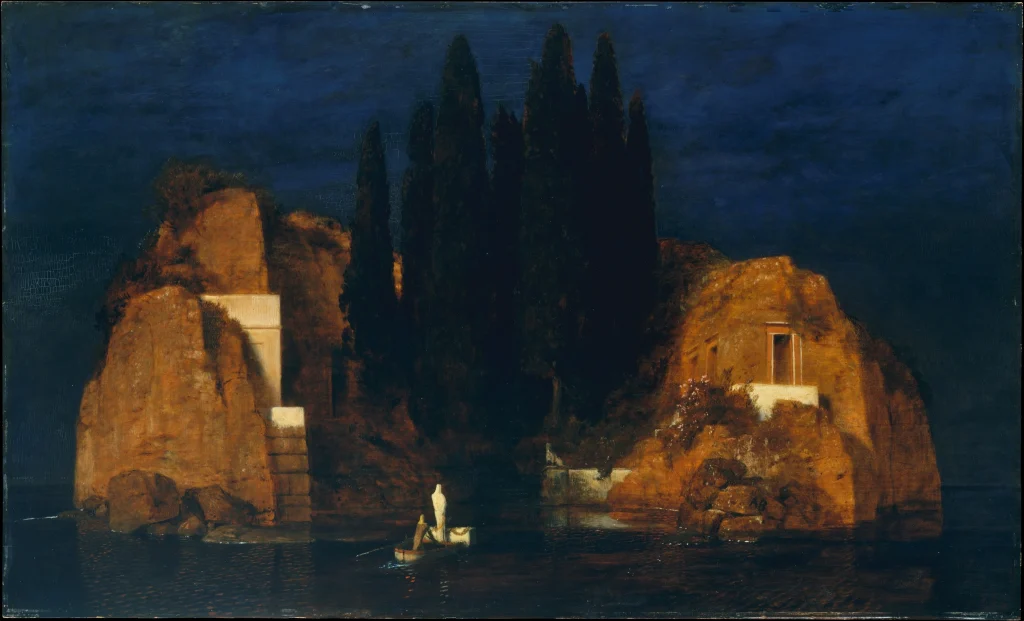
Arnold Böcklin, Island of the Dead, 1880 · The Metropolitan Museum of Art · Public Domain
On Spirit and Psychoanalysis
Spirit originates from the Latin spiritus, meaning breath, and spirare, to breathe. The Greek pneuma also means breath, wind and spirit, while psychē, the root of psychology and psychoanalysis, signifies life and soul.1 These terms have philosophical and theological legacies that shape how the clinic understands a person. On Spirit and Psychoanalysis traces these histories to explore what psychoanalysis encounters when speaking of psychic life and why the question of spirit endures in its practice.
For that question, the starting point is Jean Allouch’s article ‘Fragilities of Analysis’. Allouch notes that Freud used three terms, Psyche, Seele and Geist, but translation often blurs their distinctions, and only one shapes the name psychoanalysis. In Moses and Monotheism, Geistigkeit becomes important, prompting Allouch to ask whether analysis can recognise spirit as something it must address. This raises the issue of what psychology’s language enables clinicians to see and what it may obscure.2
To name what is obscured, Allouch draws on Foucault’s view of spirituality to focus on the transformation a subject undergoes to attain truth. Because what is discovered in speaking can unsettle the speaker’s position, analysis is deeply tied to this process. Allouch also examines how language creates pain and how analysis might reverse certain signifying structures. Spirit is thus connected to both the content and the act of speaking in analysis.
The link between spirit and speech is something that the seminar will explore in Lacan’s work, with particular attention given to his references to the Holy Spirit. In Seminar IV, Lacan connects the Holy Spirit with the appearance of the signifier; the discussion will look at how breath acts as a signifier and life as that which is signified, that is to say how speech names, addresses and gives meaning to existence. Death is introduced into the analysis through Lacan’s identification of the signifier with Freud’s death drive; his later reference to the Holy Spirit in Seminar XV, in relation to the Church and the subject who is supposed to know, further associates the question of spirit with authority and institutional knowledge.3
Such authority also shapes clinical practice, and the seminar will consider how. Concepts like ‘normality’, ‘adaptation’ and ‘responsibility’ carry implicit standards for how one should live. An inherited Geist can dictate how suffering is interpreted and what kind of life treatment seeks to achieve. Lacan’s claim that ‘the unconscious is politics’ will be examined through the ways these signifiers acquire authority, both in psychoanalysis and beyond.4
Images and signifiers gain authority, and one such image is included with the seminar: Böcklin’s Isle of the Dead, in this painting the living trees, the boat, the coffin, and the figure in white all appear together to bring together the elements of life and death. The image’s power to captivate also has a political history; the 1883 version was shown at Adolf Hitler’s Berghof and afterwards in the Reich Chancellery. In The Interpretation of Dreams, Freud connects a dream image in the style of Böcklin with the case of Dreyfus on Devil’s Island.5 The various ways in which this image has been associated with different events provide the seminar with a means of dealing with what takes hold of a person and what may go on to animate a political world.
For one such political world, the seminar turns to Jung’s 1936 interpretation of Wotan, which understands National Socialism as a collective state of possession. His discussion of the god of wind and frenzy extends to Christ, Christian pneuma and Pentecost.6 Jung’s notion of the numinosum in Psychology and Religion, an overwhelming experience beyond one’s will, links to his analysis of the soul, anima, animus and spirit as related to wind and breath.7 These perspectives return the political focus to the seminar’s core vocabulary, where what gives life can also bind a person to unrecognised demands.
Bion observes the same doubleness in the function of speech, as he points out in Attention and Interpretation.
Sometimes the function of speech is to communicate experience to another; sometimes it is to miscommunicate experience to another. Sometimes the object is to achieve access to, and permit access from, a good spirit; conversely, to deny access to a bad spirit.8
The way in which a person is received through speech brings us to Christos Yannaras’s work Person and Eros, which will be studied in conjunction with Allouch’s. Yannaras considers the concept of the person in terms of relationship and ec-stasis, that is, the movement which goes beyond the self and towards another; his interpretation of logos as disclosure will be examined in relation to Lacan’s treatment of the signifier, with Encore being read together with the other texts on love and the limits of knowledge. The question at issue is how a person comes to be present to another via speech and what in that interaction goes beyond what either person can know beforehand.9
Participation
The seminar is addressed principally to clinicians whose work has raised questions that their training and available theories leave unsettled. Psychologists, psychotherapists and those practising psychoanalysis are welcome, as are those in supervision or analytic formation.
It is equally open to readers of philosophy and theology, and to those approaching psychoanalysis for the first time. No prior reading of Freud, Lacan or the principal texts is assumed. Meetings will be devoted to close reading and discussion, with difficult passages worked through together.
The work
The seminar will work the question of spirit in dialogue with psychoanalysis as praxis. These concerns will be developed through close reading and discussion; the sequence and number of meetings remain open.
Reading
The seminar will work closely with these two texts, returning to them throughout the series.
Person, relation, eros and logos; the distinction between knowing a person and describing their nature.
Psyche, soul and spirit; the weight analysis has accumulated, and the fragility Allouch asks it to accept.
Lacan’s Seminar XX: Encore — On Feminine Sexuality, the Limits of Love and Knowledge will serve as a companion reading, particularly for the passages on soul, love and jouissance.
Selections from Hegel, Nietzsche and Freud will accompany individual seminars, according to the questions raised by the principal texts.
Specific passages and preparation for each meeting will be confirmed as the programme develops.
Convened by
Clinical Psychologist
Psychoanalytic Practitioner
Myles practises in Richmond, Melbourne, with an orientation to Freudian and Lacanian psychoanalysis. This seminar develops his work on spirit, soul and person, and on what these questions require of those who practise.
An invitation
Register for the seminar. Leave your details below to receive the meeting arrangements from Myles.
ScheduleFriday 16 October 2026, 8:30 pm Melbourne time (AEDT).
Runs monthly thereafter.
FormatMeeting format to be confirmed.
FeeFree initially.
Questions? mylesmedwell@gmail.com